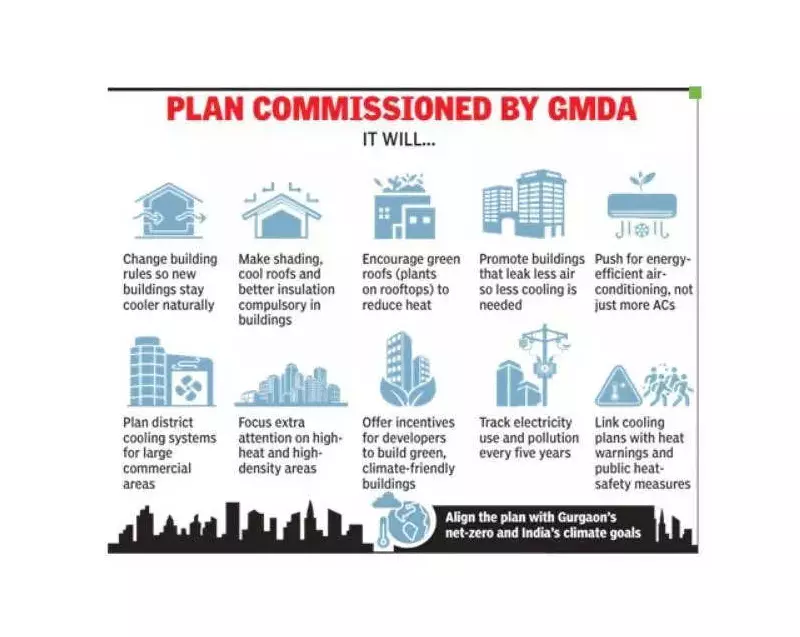
Gurugram has unveiled a comprehensive long-term strategy to address its escalating heat stress and the surging demand for air-conditioning, which threatens to spike energy consumption and emissions. The city's first-ever 'Cooling Action Plan', commissioned by the Gurugram Metropolitan Development Authority (GMDA), outlines a roadmap built on passive building design, greener construction materials, efficient cooling systems, and the development of district cooling networks.
A Blueprint for a Cooler, More Resilient Gurugram
The plan, prepared by the firm Celestial Earth, which also drafted Gurugram's Net Zero Emissions Roadmap, is deliberately aligned with the city's broader climate goals. Officials have identified cooling as "a major future driver of electricity demand and emissions in the city." The two strategies are designed to work together, ensuring that the inevitable rise in cooling needs does not derail long-term environmental targets.
Anindya Bhattacharya, Executive Director of Celestial Earth, emphasized the plan's potential. "The cooling action plan demonstrates that passive design, tighter building envelopes and targeted interventions such as green roofs and district cooling can reduce cooling energy use by up to two-thirds in some building types," he stated. He warned that without intervention, a business-as-usual path would see rising heat and unchecked AC growth significantly increase energy demand and emissions by 2050.

For perspective, in 2023, Gurugram's total cooling demand is estimated at a staggering 48.5 million gigajoule (GJ), with associated emissions of 7,035 ktCO₂ and a per capita cooling demand of 23.7 GJ.
Data-Driven Methodology and Key Interventions
What distinguishes this plan is its innovative, data-led approach. Instead of using assumed norms, it employed a machine-learning tool called SPIBEAT to calculate real building volumes across three representative sectors: Sector 52A (residential), Sector 112 (mixed-use), and Sector 16 (commercial). This provided an unusually precise baseline for an Indian city.
The analysis projects that targeted measures could cut cooling energy use by as much as 68% in some building types compared to a business-as-usual trajectory. The plan identifies several key levers:
- Tightening Building Envelopes: This emerged as the most effective strategy. Reducing air leakage, improving insulation, and shifting to triple glazing can cut cooling demand and energy use by up to 68% in residential and mixed-use buildings by 2050, with emissions falling by around 65%.
- Green Roofs with Floor Cooling: This combination performs strongly, reducing cooling demand by 53% in high-income residential buildings and by 16–18% in mixed-use and commercial areas. Emissions could drop by up to 63% in residential zones.
- Efficient HVAC Systems: Switching to systems like ceiling cooling or demand-controlled central AC offers more modest gains of 18–23% in some sectors. The plan notes that mechanical efficiency improvements alone cannot match the long-term impact of passive design.
Implementation Challenges and the Road Ahead
The plan positions cooling not as a lifestyle luxury but as a critical urban resilience issue. Subhash Yadav, Conservator of Forests, South Haryana, who commissioned the plan during his tenure as Additional CEO of GMDA, stressed the need for collective action. "With this plan, all civic agencies — including HSIIDC, MCG and the town and country planning department — need to come together for implementation," he said. He also highlighted the need to scale up treated water use, control greenhouse gas emissions, and align future development with climate goals.
The report acknowledges specific challenges, particularly in Gurugram's commercial core, represented by Sector 16, which records the highest current cooling load and emissions. Due to the dominance of sealed glass façades and deep-plan offices, even aggressive measures like green roofs and efficient HVAC together are projected to lower future cooling demand by only 12–17% in such areas.

The 2050 business-as-usual scenario flags hotter summers, intensifying urban heat islands, and a steep rise in cooling loads driven by population growth, high-rise development, and rising incomes. The Cooling Action Plan presents a vital, evidence-based strategy to steer the city towards a more sustainable and livable future, mitigating the environmental cost of staying cool.