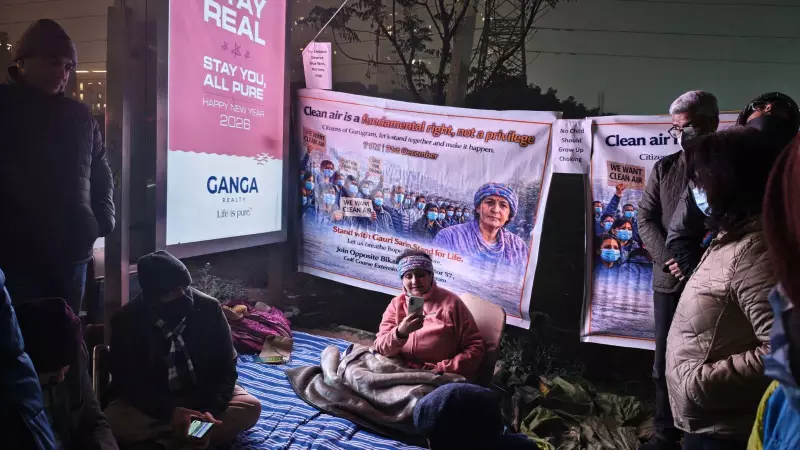
As Gurgaon celebrated the arrival of 2026, a group of concerned citizens led by social worker Gauri Sarin chose a starkly different observance. They welcomed the New Year with a 24-hour symbolic fast, demanding urgent action against the city's deteriorating air quality, which has plunged to its worst December levels in at least eight years.
A Personal Wake-Up Call Sparks Public Protest
Gauri Sarin, the convener of the citizen initiative Making Model Gurugram (MMG), had never suffered from bronchial issues. However, in December 2025, a severe, persistent cough afflicted her for over 20 days. "The polluted air had finally got to me too," she stated, marking this personal health crisis as the catalyst for her public action.
On December 31, at 7 PM, Sarin began her protest near the Sector 62 bus stop on Golf Course Extension Road. Braving the cold and fog with a dozen volunteers, her fast aimed to highlight governmental inaction. She sharply criticized the failure to implement basic measures under the Graded Response Action Plan (GRAP), the mandated protocol for the National Capital Region during high pollution periods.

Systemic Failure and a "Pro-People" Stand
"They are not adhering even to basic GRAP norms," Sarin asserted. She pointed out that dust suppression through water sprinkling was done poorly and only as a temporary cover. She accused authorities of shifting the responsibility to private enterprises while neglecting to curb industrial pollution and vehicular emissions.
Emphatically distancing her protest from politics, Sarin clarified her fast was a "pro-people" action. She expressed concern that a majority of Gurgaon's high-rise residents might be disconnected from the severity of the problem. "That is why I am fasting... I will quit Gurgaon if nothing is done on pollution," she declared, underscoring her personal stake in the issue.
Her stance found solidarity among other activists. Environmentalist Vaishali Rana, who joined the protest, lamented the need for such demonstrations while dust and pollution persist unchecked. The group plans to continue raising awareness through relay fasts.
The Alarming Data Behind the Protest
The protest was grounded in hard, troubling statistics. Data from the Central Pollution Control Board (CPCB) reveals the scale of the crisis:
- Gurgaon's average Air Quality Index (AQI) in December 2025 soared to 298, the worst in eight years, barely missing the "very poor" category.
- The month had zero days with "moderate" air quality. For 13 days, the AQI exceeded 300.
- The most severe spell was from December 18 to 22, with AQI levels ranging from 322 to 364.
- Gurgaon's annual average PM2.5 concentration in 2025 was approximately 80 µg/m³. This is double India's national standard and a staggering 16 times higher than the WHO's safe limit of 5 µg/m³.
The protest yielded a immediate, if tentative, response. Sarin reported that after midnight, the Commission for Air Quality Management (CAQM) contacted her, promising "major clean-ups to address the dust." However, for Sarin and her fellow volunteers, this is just a first step. Their New Year's resolution is clear: sustained public pressure for a breathable, pollution-free Gurgaon, turning personal health anguish into a collective civic demand.