Haryana Submits Comprehensive Air Quality Action Plan with Focus on Gurgaon
In a significant move to combat air pollution, the state of Haryana has formally submitted its annual action plan to the Commission for Air Quality Management (CAQM). The plan, delivered on Sunday, outlines a robust strategy with a special emphasis on the National Capital Region (NCR), including key urban centers like Gurgaon and Manesar.
State-Wide and City-Specific Pollution Reduction Targets
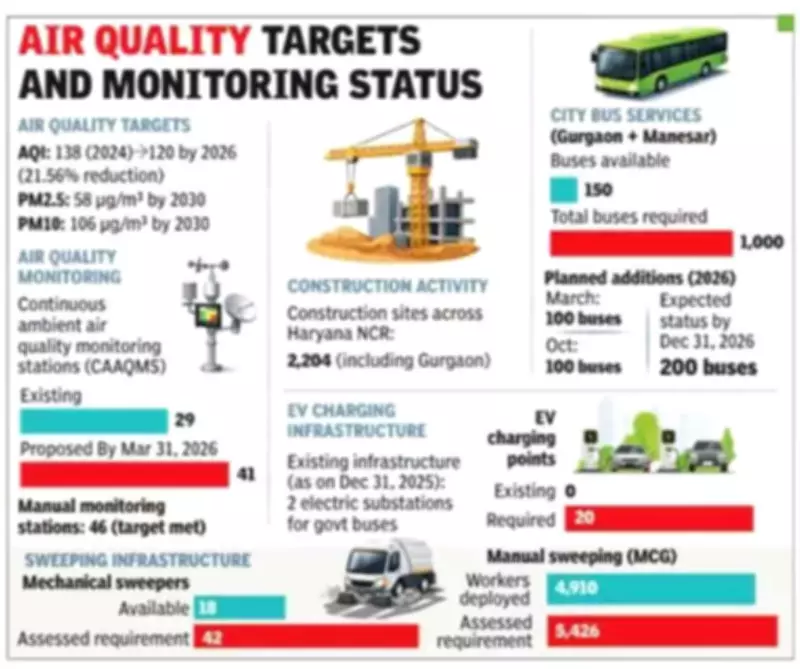
The cornerstone of Haryana's strategy is a clear numerical target: to reduce the state's average Air Quality Index (AQI) levels by 21.5% by the end of the current year. This ambitious goal is part of a longer-term vision. The plan projects that Haryana's annual average AQI, which was recorded at 138 in 2024, will be brought down to 120 by the conclusion of 2026.
For particulate matter, the state has set even more forward-looking objectives. By the target year of 2030, Haryana aims to reduce the annual average concentration of PM2.5 to 58 micrograms per cubic meter (µg/m³) and PM10 to 106 µg/m³. These targets underscore a sustained commitment to improving air quality over the next several years.

Gurgaon's Roadmap: Dust Control and Public Transport
The action plan dedicates substantial attention to Gurgaon, outlining city-specific implementation measures. A primary focus is on controlling road dust, a major contributor to particulate pollution. The city has identified 294 roads to be covered for dust control measures in 2026, with monthly targets set between 22 and 27 roads. Furthermore, the plan mandates that 50 kilometers of road length must be treated for dust control each month throughout the year.
To support these efforts, the plan assesses Gurgaon's current mechanical sweeping capacity. Presently, the city operates 18 mechanical road sweeping machines, but the assessed requirement is significantly higher at 42 machines. For minor and narrow roads where mechanical sweeping is not feasible, manual sweeping is being carried out by 4,910 workers, slightly short of the assessed requirement of 5,426 workers. The Municipal Corporation of Gurgaon (MCG) is overseeing eight ongoing works in this category.
Public transportation forms another critical pillar of the strategy. The plan highlights a severe shortfall in city bus services for Gurgaon and Manesar combined. While the total requirement is estimated at 1,000 buses, only 150 are currently available, leaving a gap of 850 buses. To address this, the plan sets a phased target: adding 100 buses in March 2026 and another 100 in October 2026, with an expected total of 200 additional buses by December 31, 2026.
Enhancing Monitoring and Electric Vehicle Infrastructure
Accurate data is vital for effective policy. Haryana currently operates 29 Continuous Ambient Air Quality Monitoring Stations (CAAQMS) and has proposed increasing this number to 41 by March 31, indicating a need for 12 new stations. The state has already met its target for manual air quality monitoring stations, which stand at 46.
In line with global shifts towards sustainable mobility, the plan also addresses electric vehicle (EV) infrastructure in Gurgaon. As of December 31, 2025, the city has only two electric substations for government buses. The total requirement for EV charging points is pegged at 20, with the plan noting a current gap of all 20 points. To bridge this, quarterly targets for 2026 include installing 10 charging points in the second quarter (April–June) and another 10 in the third quarter (July–September), aiming for a total of 20 operational charging points by the end of 2026.
The Urgency of Action: Gurgaon's Pollution Reality
The necessity of this comprehensive plan is underscored by Gurgaon's alarming air quality data. A recent monthly analysis by the Centre for Research on Energy and Clean Air (CREA) revealed that Gurgaon ranked 4th worst nationally for air pollution. The city's PM2.5 levels remained in the 'very poor' to 'severe' categories on 25 out of 31 days in the analyzed month, with a mean concentration of 163 µg/m³.

This figure is nearly three times higher than India's daily National Ambient Air Quality Standard of 60 µg/m³ and approximately ten times the World Health Organization's (WHO) recommended guideline of 15 µg/m³. The plan also notes that Haryana has 2,204 construction sites across the NCR region, including in Gurgaon, which will be covered under specific dust mitigation measures, highlighting the scale of the challenge.
With its blend of state-wide targets and granular, city-specific actions for Gurgaon—encompassing dust control, public transport augmentation, monitoring enhancement, and EV infrastructure development—Haryana's action plan represents a multi-faceted approach to tackling the persistent and severe air quality crisis in one of its most important economic hubs.