

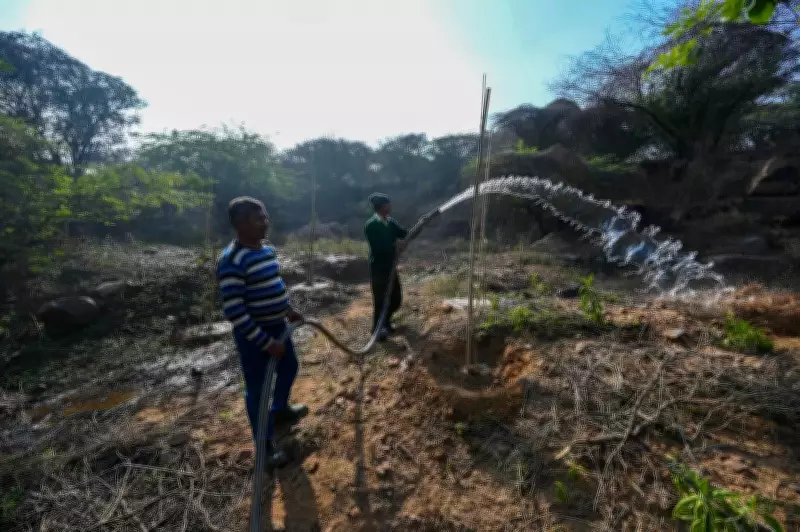
Gurgaon: Haryana ranks lowest among Indian states in forest cover, according to the Forest Survey of India's (FSI) 2021 report, and has now sharply curtailed its plantation outreach. While the Delhi government prepares to distribute saplings free of cost through “Vriksh Rath” vehicles and geo-tag every planted tree this monsoon, Haryana has stopped free sapling distribution and is drastically reducing its plantation target this year.
Free Sapling Distribution Halted
According to forest department officials, free distribution of saplings has been stopped, and temporary restrictions imposed on supplying plants to institutions and educational bodies. When contacted by TOI, officials said the free distribution of saplings has been stopped as the government believes many of the plants handed out earlier were “neither properly planted nor maintained.”
A forest official, requesting anonymity, told TOI, “A complete halt on free sapling distribution is not justified. Instead of stopping public participation, the focus should be on better monitoring, survival audits and involving local communities in maintenance. In a state like Haryana, where tree cover is already critically low, reducing access to saplings sends the wrong message.”

Contrasting Approaches
The contrasting approaches highlight two very different responses to concerns over plantation survival and accountability. Environmentalist Vivek Kamboj said, “While Delhi is attempting to expand public participation alongside stricter monitoring mechanisms, Haryana appears to be scaling back public distribution itself amid scrutiny over plantation outcomes.” The development assumes significance as Haryana continues to grapple with low forest and tree cover, particularly in rapidly urbanising districts such as Gurgaon and Faridabad, where green spaces have come under increasing pressure from construction, mining and infrastructure expansion.
Government's Stand
Haryana forest and environment minister Rao Narbir Singh said, “The forest department has been directed to restrict free distribution of saplings. The concern is that many of the plants distributed earlier were not maintained properly after plantation, which affected their survival.” He, however, clarified that saplings are still available for individuals and groups genuinely interested in plantation activities. “Serious planters can still visit government nurseries and obtain saplings by paying a nominal amount of around Rs 10 per plant,” the minister said.
Environmental Impact
The pullback also comes amid an intense summer during which several Haryana districts have recorded temperatures above 43 degrees Celsius. Despite being home to the Aravalis, only 3.6% of Haryana’s area is officially tagged as forests. The FSI report also noted an 8% decline in Haryana’s tree cover between 2019 and 2021, from 1,565 square kilometres to 1,425 square kilometres. In Gurgaon last year, 1,89,500 plants were distributed for free.
Delhi's Aggressive Campaign
In contrast, the Delhi government has announced an aggressive plantation campaign for the upcoming monsoon season. Under the initiative, the forest department will deploy “Vriksh Rath” vehicles across all 13 districts to distribute saplings free of cost and assist residents in plantation activities. Delhi environment minister Manjinder Singh Sirsa recently said the capital has set a target of planting 70 lakh saplings through 22 departments this year. Officials have also announced that every sapling planted under the drive will be geo-tagged and geo-fenced for real-time monitoring.
The Delhi government has additionally proposed Green Awards to recognise schools and institutions ensuring long-term survival of planted trees, with officials stressing that plantation should become “a culture, not just an event.”
Expert Views
Environmentalist Kamboj added, “The move could directly impact RWAs, schools, NGOs and village bodies that routinely depend on free sapling distribution during annual monsoon plantation drives.”






