

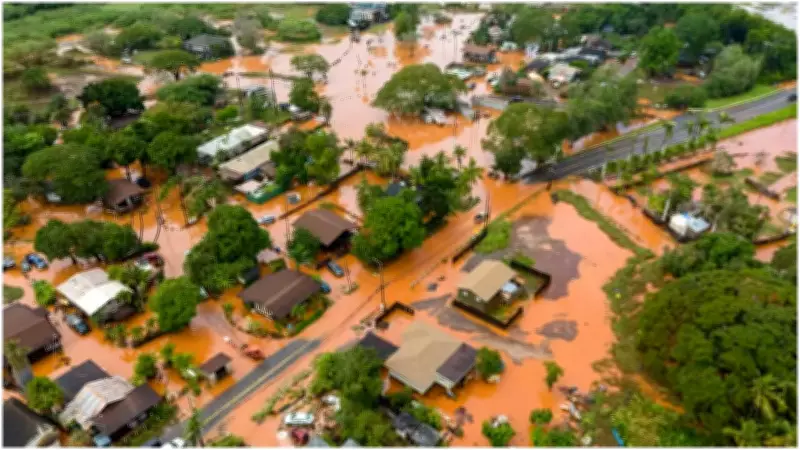
Hawaii Grapples with Catastrophic Flooding, Worst in Over Two Decades
Hawaii is reeling from its most devastating flooding event in more than 20 years, triggered by relentless heavy rains that fell on soil already waterlogged from a winter storm just a week prior. The crisis prompted officials to issue urgent "LEAVE NOW" warnings early Saturday for residents in the hardest-hit areas, as more rainfall was forecasted for the weekend.
North Shore Oahu Submerged, Evacuations Ordered
Muddy floodwaters have engulfed vast expanses of Oahu's iconic North Shore, a region famous for its legendary big-wave surfing. Raging waters lifted homes and vehicles, leading to evacuation orders for approximately 5,500 people north of Honolulu. Authorities have raised alarms about the potential failure of a 120-year-old dam, heightening fears of further disaster.
"The remaining access road out of Waialua is at high risk of failure if rainfall continues," stated an emergency alert, underscoring the precarious situation. On Maui, evacuation advisories were upgraded to warnings for parts of Lahaina, a community still recovering from a deadly 2023 wildfire, due to retention basins nearing capacity.

Rescues and Narrow Escapes Amid Rising Waters
More than 200 individuals were rescued from the surging floodwaters, with no fatalities reported and all accounted for. Rescue teams conducted extensive searches by air and water for stranded people. Among the harrowing stories, Waialua farmer Racquel Achiu described finding her goats in knee-high water and her family's seven dogs nearly drowning in an elevated kennel, saved only by her nephew and son-in-law braving chest-high waters.
"My dogs' heads were literally just sticking out of the water," Achiu recounted. "There was so much water, I cannot even express."
Economic Impact and Federal Response
Governor Josh Green warned that the storm's financial toll could surpass $1 billion, encompassing damage to airports, schools, roads, homes, and a hospital in Kula, Maui. "This is going to have a very serious consequence for us as a state," Green emphasized during a news conference, noting that his chief of staff had secured assurances of federal support from the White House.
This flooding event marks Hawaii's most severe since 2004, when homes and a University of Hawaii library were inundated. While dozens to hundreds of homes have been damaged, a full assessment of the destruction remains pending.
Meteorological Factors and Climate Change Link
The deluge has been attributed to "Kona lows," winter storm systems characterized by southerly or south-westerly winds that transport moisture-laden air. Parts of Oahu received 8 to 12 inches (20 to 30 cm) of rain in a short period, exacerbating the flooding on already saturated land. Experts point to human-caused global heating as a factor increasing the intensity and frequency of such heavy rainfall events in Hawaii.
Ongoing Threats and Community Resilience
Officials continue to monitor the Wahiawa dam, located about 17 miles northwest of Honolulu, which has been deemed "at risk of imminent failure" for decades. Water levels fluctuated with overnight rain, though concerns have shifted to the broader hazardous conditions across the island.
Molly Pierce, a spokesperson for Oahu's department of emergency management, highlighted substantial flooding in residential areas of Honolulu, cautioning that even minimal additional rain could cause waters to rage back up due to soil saturation. "So even if it's blue skies where you are, I think we all know in Hawaii that if rain is falling on the mountain, it's coming to you soon enough," Pierce advised.
Despite moments of receding waters and blue skies that heartened some North Shore residents who chose not to evacuate, meteorologist Tina Stall of the National Weather Service in Honolulu urged vigilance: "Don't let your guard down just yet. There's still potential for more flooding impacts."






