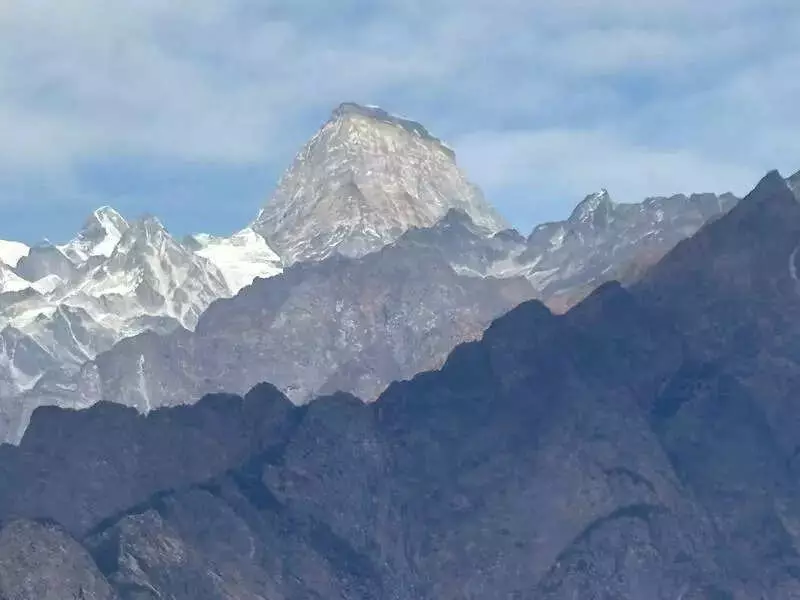
Himalayan Snowlines Retreat Upward, Signaling Accelerating Climate Change
From Uttarakhand's river valleys to the slopes below Mount Everest, scientists are documenting a clear trend. The snowline across large parts of the Himalayas is steadily retreating upward. This movement offers one of the most visible signals yet of accelerating climate change in the world's highest mountain range.
Below Normal Snowfall Deepens Concerns
Snowfall across much of the Indian Himalayan region has been significantly below normal this winter. This fact deepens concerns among researchers about thinning snowpacks and early melt. The long-term impacts on water security are becoming a major worry.
Professor Anjal Prakash, an IPCC author and research director at the Bharti Institute of Public Policy, Indian School of Business, confirms the evidence. "There is clear evidence that the seasonal snowline has shifted upward in many parts of the Himalayas over the past 2-3 decades," he said. "Warmer temperatures and reduced snowfall are exposing more rock and ice at elevations that were previously snow-covered during winter and spring."

Satellite Data Reveals Stark Trends
Satellite-based research strongly supports this assessment. The latest findings from the Kumaon Himalayas further reinforce the trend. Scientists from Kumaon University analyzed satellite data from 1990 to 2022. They found that the average snowline in the Gori Ganga watershed rose by about 520 meters. This climb went from roughly 4,665 meters to 5,185 meters, averaging over 16 meters per year.
The study also documented a parallel upward shift in vegetation and treeline boundaries. This indicates a broader ecological response to the changing climate. Vegetation boundaries moved upslope by nearly 596 meters, while the treeline advanced by about 680 meters.
"Snowline, vegetation line, treeline and the citrus fruit belt in Gori Ganga basin shifted from lower elevations to higher ground," said professor DS Parihar of Kumaon University. He pointed to sustained warming and reduced snow persistence that now allow forests and crops to colonise elevations once dominated by snow.
Signals from Everest and Beyond
Similar signals are emerging farther east. A recent NASA study used Landsat satellite data. It recorded unusually high winter snowlines in the Mount Everest region. Snow retreated upslope by nearly 490 feet within two months during the 2024-25 winter. Scientists said the findings suggest snow is increasingly failing to accumulate at lower elevations even during peak winter months. This is another worrying indicator of how rapidly conditions are changing.
Beyond individual basins, multi-basin satellite analyses across the Himalayas show statistically significant snowline rise. This is evident in several glaciated and monsoon-influenced catchments such as Langtang, Hidden Valley and Rolwaling in Nepal.
"Yes, the snowline is moving up," Prakash said. He added, "The trend is not uniform. Some western sites, such as Satopanth, show a declining snowline linked to increased winter snowfall, while some eastern basins show no clear trend, underscoring strong regional contrasts."
Recent Studies Confirm the Pattern
These contrasts are reflected in multiple recent studies. A 2025 study by scientists from Tribhuvan University, Nepal, examined the Langtang Basin. It found that snow-covered area declined sharply between 1988 and 2024. The snowline rose by about 2.2 meters per year, confirming a long-term upward migration of seasonal snowpack.
A 2024 Springer-published study from Uttarakhand's Pindari River Basin documented a similar pattern. It showed steady snowline rise and shrinking snow-covered area over several decades, driven largely by rising temperatures.
An international study involving scientists from Japan, Switzerland and Austria reinforced these findings. It recorded snowline rises of 14.4 meters per year in Langtang, 11.9 meters per year in Hidden Valley and 8.2 meters per year in Rolwaling. Researchers largely attributed this to warmer monsoon-season temperatures. In contrast, the Satopanth basin in the western Indian Himalaya showed a declining snowline trend of about 15.6 meters per year. This was linked to higher winter snowfall and reduced monsoon melt.

Drivers Behind the Upward Shift
Climate scientists say the drivers behind the overall upward shift are becoming increasingly clear. "Himalayas are warming faster than the global average," Prakash said. "Even small temperature increases push the 0-degree isotherm upslope. This means precipitation that fell earlier as snow is now increasingly falling as rain." He added that snow droughts, erratic snowfall and weakening western disturbances are further reducing snow supply to mid-elevation ranges.
Local factors also shape how the snowline behaves. Piyoosh Rautela, geologist and former executive director of Uttarakhand State Disaster Management Authority, explained that slope orientation plays a critical role. "South-facing slopes receive more direct sunlight, leading to higher temperatures and faster melt, so snowlines tend to be higher there. North-facing slopes remain cooler and shaded, allowing snow to persist at lower elevations."
Impacts on Glacier Health and Water Security
The changing snow regime is already affecting glacier health. Manish Mehta, a glaciologist at the Wadia Institute of Himalayan Geology, said both snowfall extent and snowfall days are declining across the Himalayas. Rainfall is increasing simultaneously.
Mass balance studies of the Dokriani and Chorabari glaciers in Uttarakhand and the Pensilungpa glacier in Ladakh show a consistent upward shift in the equilibrium line altitude. This is a key indicator of glacier stability directly linked to reduced snowfall. "These consistent upward shifts clearly show that the snowline in the Himalayas is moving higher," Mehta said.
Veteran glaciologist and former scientist at Wadia Institute, DP Dobhal, noted that snowline elevations across the Himalayas rose markedly over the past 4-5 decades. "In parts of western Himalaya, snow that was earlier observed around 4,800-5,000m is now found above 5,200m," he said. He added that central Himalaya saw snowlines climb to around 5,000–5,200m, from earlier 4,800-5,000m.
Scientists warn that a rising snowline weakens the Himalayas' natural water storage system. It disrupts river flows and further heightens long-term risks to water security, ecosystems and livelihoods across the Indian subcontinent. So, as winter retreats upslope, the consequences are flowing steadily downstream.