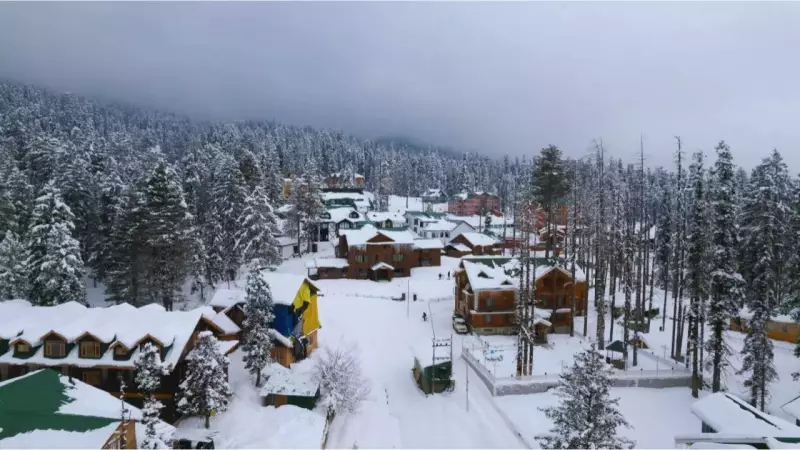
As India prepares to ring in 2026, the nation is bracing for a powerful bout of winter weather that promises to significantly impact celebrations and travel. The India Meteorological Department (IMD) has issued a detailed forecast, warning of a potent mix of heavy snowfall, dense fog, and biting cold waves set to sweep across multiple regions in the coming days.
Western Himalayas Brace for Heavy Snowfall and Disruptions
According to the All India Weather Summary and Forecast Bulletin released on December 30, 2025 (7:50 PM), the western Himalayan region is on high alert. The IMD predicts heavy snowfall at isolated locations in Jammu and Kashmir and Ladakh for three consecutive days. This intense weather raises serious concerns about road blockages, the temporary closure of crucial mountain passes, and major disruptions to travel in the higher reaches.
Furthermore, the forecast includes the possibility of thunderstorms accompanied by lightning at isolated places, adding another layer of risk. Neighboring states like Himachal Pradesh and Uttarakhand are also expected to receive isolated to scattered light to moderate rainfall or snowfall from December 30 through January 2.

Dense Fog to Shroud North and East India
One of the most widespread challenges will be fog. The IMD bulletin highlights the continuation of dense to very dense fog during night and early morning hours across vast swathes of north, central, and eastern India. States including Punjab, Haryana, Chandigarh, west Uttar Pradesh, and Delhi are likely to experience these severe fog conditions until at least January 1, with spells continuing beyond.
The fog blanket will extend to east Uttar Pradesh and Odisha till January 2, with isolated dense pockets forecast over Rajasthan, Madhya Pradesh, Bihar, Jharkhand, sub-Himalayan West Bengal, Sikkim, Gangetic West Bengal, Assam, Meghalaya, and other northeastern states.
Visibility has already plummeted in many areas. As of 1730 hours IST on December 30, Shillong recorded a mere 50 metres visibility, while Barabanki and Jalpaiguri reported visibility reduced to 200 metres.
Cold Wave and Severe Cold Day Conditions Loom
The chill is set to intensify sharply. The IMD has issued warnings for cold wave, cold day, and severe cold day conditions across several states. Isolated pockets of east Uttar Pradesh have already reported cold day to severe cold day conditions, with similar conditions noted in parts of Bihar, Gangetic West Bengal, and west Uttar Pradesh.
The forecast indicates that cold wave conditions are likely in isolated pockets of eastern Madhya Pradesh, Jharkhand, Chhattisgarh, Telangana, north interior Karnataka, and parts of Himachal Pradesh in the next few days. West Rajasthan is expected to experience a cold wave around January 2 and 3.
Minimum temperatures are running appreciably below normal in several regions, including East Madhya Pradesh, Chhattisgarh, and Gangetic West Bengal. Nowgong in Madhya Pradesh recorded the lowest minimum temperature over the plains at a frigid 3.0 degrees Celsius.
Travel Advisories and Coastal Warnings
The IMD has explicitly warned that the dense fog will affect a large number of destinations, particularly in the north and east. Travellers should anticipate significant delays at airports, on highways, and across railway routes, especially during night and early morning hours. Reduced visibility will lead to slower journey times and an increased risk of road traffic accidents, prompting authorities to advise extreme caution.
Beyond the mainland, the Andaman and Nicobar Islands may see isolated thunderstorms with lightning and gusty winds (30–40 kmph) between December 30 and January 1. From January 1 onwards, squally winds reaching 45–55 kmph, gusting to 65 kmph, are likely along and off the Somalia coast, over the Gulf of Mannar, and parts of the Comorin area.

As the country steps into the New Year, the IMD urges citizens, travellers, and local administrations to remain vigilant and consistently check official weather advisories. With a confluence of an active western disturbance, jet streams, and upper-air circulations driving this severe weather, winter is decisively announcing its presence across India.