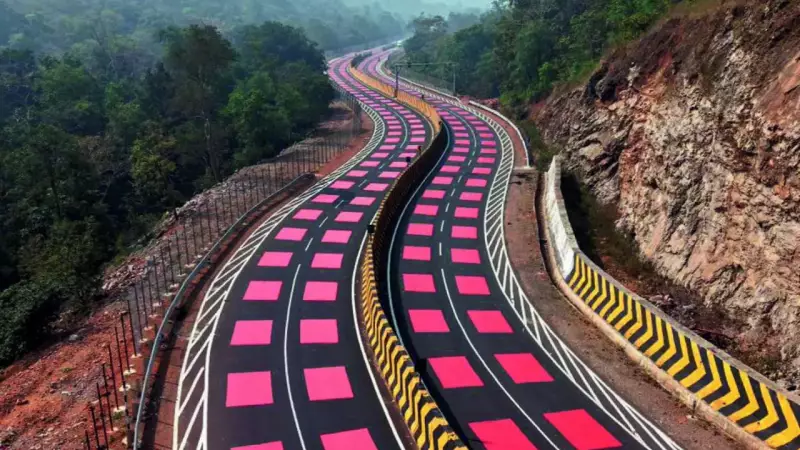
In a pioneering move for conservation, the National Highways Authority of India (NHAI) has officially launched the country's first integrated 'wildlife-safe' road corridor. This innovative project is located on a crucial forested section of the Bhopal-Jabalpur national highway (NH-45), which cuts through the vital Veerangana Durgavati Tiger Reserve in Madhya Pradesh.
The 'Red Road' Innovation: Slowing Speed to Save Lives
The centerpiece of this 12-kilometer stretch is a unique 2-kilometer zone where the asphalt is overlaid with a bright red, 5mm thick thermoplastic surface. NHAI Regional Officer S K Singh explained that this 'table-top' layer serves a dual purpose. Visually, the striking red color immediately alerts drivers they are entering a sensitive wildlife area. Physically, the slightly raised texture creates a mild vibration under vehicle tyres, encouraging drivers to instinctively reduce speed without the need for dangerous sudden braking or traditional speed breakers unsuitable for highways.
"As per my knowledge, it is the first such concept implemented in the country," Singh stated. This design directly tackles the core issue identified by conservationists: speed. On highways widened from two to four lanes, like NH-45, faster vehicles and increased traffic volumes have historically led to frequent and fatal collisions with animals crossing the road.

Beyond the Surface: Fences and Underpasses for Safe Passage
While the red road manages vehicle speed, a more conventional but critically planned infrastructure lies beneath. NHAI has constructed 25 dedicated wildlife underpasses along this forest section. The locations were carefully chosen based on observed animal movement patterns, not just engineering convenience. To guide animals safely to these crossings, continuous iron fencing runs on both sides of the highway, preventing them from wandering onto the carriageway randomly.
This holistic approach—controlling where animals cross and how vehicles move—aims to drastically reduce animal fatalities. Similar structures in other parts of India, like near Pench Tiger Reserve, have proven that when underpasses align with natural routes, a wide range of animals, from deer to large carnivores, readily use them.
A Model for the Future of Infrastructure in Forest Areas
The project has drawn positive reactions from experts. Former IFS officer and wildlife expert Jagdish Chandra affirmed the potential of the red-road concept, stating, "There will be positive results. This is the first such project implemented in the country."
This corridor on NH-45 represents a significant shift in how India builds infrastructure through ecologically sensitive zones. By integrating speed-calming design, scientific monitoring, and purpose-built animal crossings, it sets a new standard for balancing developmental needs with urgent conservation imperatives, offering a replicable model for other highways traversing the nation's precious forests and wildlife habitats.