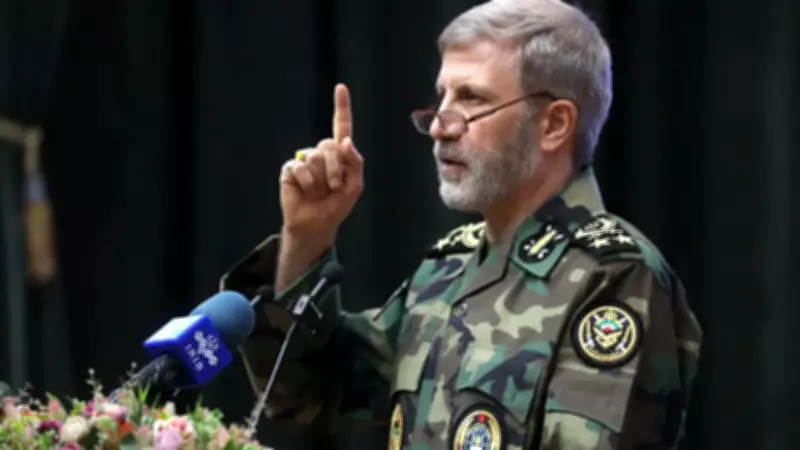
Iran's Military Leadership Issues Stern Warning to United States and Israel
Iran's army chief, General Amir Hatami, delivered a forceful warning to the United States and Israel on Saturday, declaring that the country's armed forces are maintaining maximum defensive readiness in response to significant American military movements in the Persian Gulf region. The statement, reported by international news agency AFP, comes amid escalating regional tensions and domestic unrest within Iran.
Direct Threats and Military Posturing
According to Iran's official IRNA news agency, General Hatami explicitly cautioned that "if the enemy makes a mistake, without a doubt it will endanger its own security, the security of the region, and the security of the Zionist regime." He emphasized that Iranian forces remain "at full defensive and military readiness" to respond to any potential aggression.
The warning follows substantial US military deployments to the Middle East, including a naval strike group led by the USS Abraham Lincoln aircraft carrier. These movements occurred against the backdrop of President Donald Trump's threats of possible military action following Iran's crackdown on widespread anti-government protests.

Nuclear Program Defiance and Diplomatic Stance
General Hatami further asserted that Iran's nuclear capabilities remain invulnerable to external pressure, stating that "the nuclear science and technology of the Islamic Republic of Iran cannot be eliminated, even if scientists and sons of this nation are martyred." This declaration reinforces Tehran's longstanding position regarding its nuclear development program.
Despite the heightened rhetoric, diplomatic channels remain partially open. Iranian Foreign Minister Abbas Araghchi has indicated Tehran's willingness to engage in nuclear negotiations, though he firmly stated that Iran's missile and defense capabilities "will never be negotiated." President Trump has similarly suggested that Iran might seek a diplomatic resolution to avoid conflict over its nuclear and missile programs.
Domestic Unrest and International Accusations
The geopolitical tensions coincide with significant domestic challenges within Iran. Nationwide protests that began on December 28 over economic hardships and rising living costs have evolved into broader anti-government demonstrations. Official figures cited by AFP report at least 3,117 fatalities, while the US-based Human Rights Activists News Agency (HRANA) has verified approximately 6,563 deaths, including over 6,000 protesters and 124 children.
Iranian authorities have accused the United States and Israel of orchestrating the unrest, characterizing it as a "terrorist operation" designed to destabilize the country. Meanwhile, President Masoud Pezeshkian has urged government officials to address public grievances, emphasizing that "we must work with the people and for the people and serve the people as much as possible."
Regional Developments and Religious Observances
Amid the political and military tensions, Supreme Leader Ayatollah Ali Khamenei visited the shrine of Ruhollah Khomeini in southern Tehran on Saturday, offering prayers during the ten-day celebrations marking the 47th anniversary of the 1979 Islamic Revolution. This symbolic gesture underscores the regime's connection to its revolutionary foundations during a period of internal and external pressure.
The United States Central Command (CENTCOM) has responded to the escalating situation by warning Iran against "any unsafe and unprofessional behaviour near US forces" in the region. This exchange highlights the precarious nature of current US-Iran relations and the potential for miscalculation in the strategically vital Persian Gulf.
The convergence of military posturing, nuclear program disputes, domestic protests, and diplomatic maneuvering creates a complex and volatile situation that continues to evolve, with implications for regional stability and international security frameworks.