

Iran Showcases Kamikaze Naval Drone Arsenal in Underground 'Missile City'
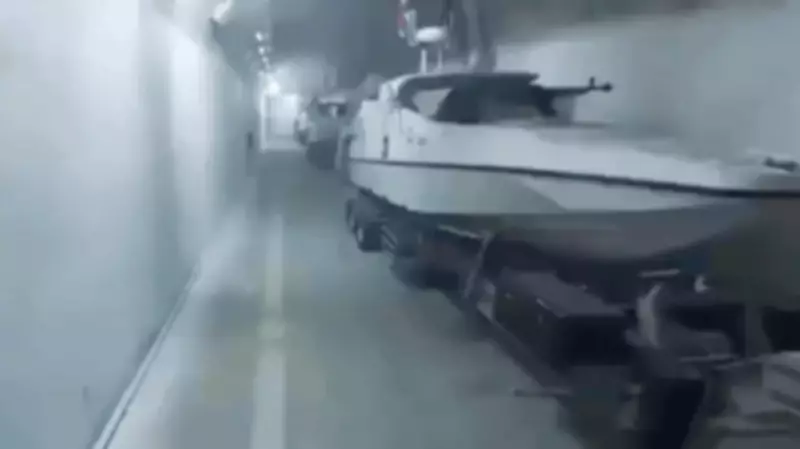
Iranian state media has released dramatic footage revealing a vast underground military facility, described as a hidden "missile city," filled with naval drones, anti-ship missiles, and sea mines. The video, which surfaced recently, provides a rare glimpse into Tehran's expanding arsenal and its potential to disrupt critical global maritime routes.
Underground Arsenal and Kamikaze Drone Capabilities
The footage showcases extensive tunnels stocked with weapons, including Ababil-2 and Ababil-3 kamikaze drones, Shahed-136 drones, and explosive-laden Zolfaqar drone boats. It also features Ghadir anti-ship cruise missiles with a range of approximately 190 miles, Nasr-1 precision anti-ship missiles, and Khalij Fars anti-ship ballistic missiles. Additionally, the stockpile includes Maham acoustic and magnetic sea mines and Sadaf-02 contact sea mines, designed for deployment in key shipping lanes.
In one segment, a naval drone is fired from a tanker, triggering a large explosion and sending thick plumes of smoke into the sky. These small, explosive-laden boats, often referred to as "kamikaze" drones, travel just below or on the water's surface and are intended for one-way strikes. Due to their low profile and rapid movement, they pose a significant detection and defense challenge, especially during nighttime operations.

Threats to Global Shipping and Strategic Warnings
Iran's military has claimed it possesses a massive stockpile of suicide drone boats capable of disrupting traffic through the Strait of Hormuz, a narrow waterway vital for global trade and oil shipments. Security analysts note that Unmanned Surface Vehicles (USVs) like these are increasingly used in modern warfare, as traditional counter-drone systems for aerial threats often prove ineffective against waterborne targets.
Brigadier General Ali Fadavi, deputy commander of the Islamic Revolutionary Guard Corps (IRGC), warned that Iran has missiles capable of being fired from underwater at speeds of 100 meters per second and may deploy them in the coming days. Authorities in Tehran have suggested that blocking the Strait of Hormuz could cause oil prices to surge to as high as $200 a barrel.
Iranian parliament speaker Mohammad Bagher Ghalibaf issued a stern warning to the United States and Israel, stating that any aggression against Iranian territory would trigger a severe response. "Any aggression against the soil of Iranian islands will shatter all restraint. We will abandon all restraint and make the Persian Gulf run with the blood of invaders," he declared.
Historical Context and Global Implications
This is not the first time Iran has showcased its underground military bases, often dubbed "missile cities." In early 2025, the IRGC unveiled several such facilities along the Gulf coast, displaying bays for suicide drone boats, cruise missiles, and ballistic missiles on mobile launchers. The earliest public reference to these bases dates back to March 2021, when the IRGC released footage of anti-ship missiles and electronic warfare systems stored deep underground, purportedly to protect the arsenal from aerial or naval bombardment.
Iranian-made naval drones have already been utilized by Houthi movement fighters in Yemen, targeting commercial vessels in the Red Sea shipping route. Similarly, Ukraine has deployed analogous drones in its conflict with Russia, employing them to attack naval assets. The proliferation of these technologies underscores their growing role in contemporary warfare and the escalating threats to international maritime security.






