

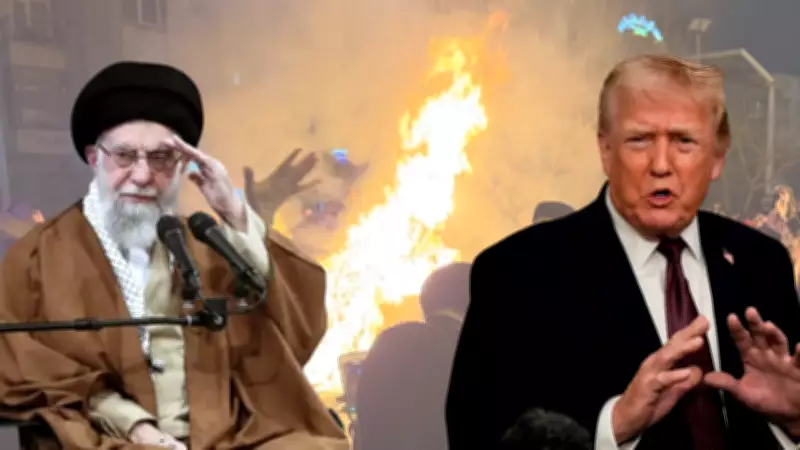
Iran's Military on Highest Alert Amid Escalating US Tensions
While no sirens have sounded and no missiles have been fired, inside Tehran's corridors of power, Iran is behaving as if war with the United States is no longer a distant possibility but an approaching reality. Senior commanders are on heightened alert, missile units are being repositioned, and security forces are preparing for potential unrest at home.
Military Repositioning and Strategic Posturing
According to senior Iranian officials cited by The New York Times, the armed forces have been placed on the highest level of alert. Ballistic missile launchers have been strategically repositioned along Iran's western frontier with Iraq, within striking distance of Israel, and along its southern coastline on the Persian Gulf, where US bases and naval assets are concentrated.
In recent weeks, Iran has periodically closed its airspace to conduct missile tests and has staged naval drills that briefly disrupted shipping through the Strait of Hormuz, a critical chokepoint through which roughly one-fifth of global oil passes.

Supreme Leader Ayatollah Ali Khamenei recently warned in a public address, "The most powerful military in the world might receive such a slap that it won't be able to get on its feet," vowing retaliation if attacked and threatening US warships gathered nearby.
Domestic Preparations and Asymmetric Warfare Doctrine
Iran's preparations extend beyond external battlefields. Officials confirm that special police units, intelligence operatives, and the Basij militia—subordinate to the Islamic Revolutionary Guard Corps (IRGC)—are ready to deploy across major cities in the event of conflict. Checkpoints would be erected to deter unrest and monitor suspected foreign-linked activity, reflecting concerns that war could spark domestic instability.
Tehran's military doctrine rests on asymmetry. Lacking a modern air force capable of matching US stealth aircraft, Iran has invested heavily in ballistic missiles, cruise missiles, and long-range drones. Western analysts estimate that Iran possesses the largest missile arsenal in the Middle East, with thousands of projectiles designed to overwhelm air defenses through sheer volume.
Naval maneuvers have reinforced this strategic message. In a rare move, the IRGC temporarily closed parts of the Strait of Hormuz during exercises, signaling its ability to disrupt global energy supplies. Iran has also conducted joint drills with Russia in the Gulf of Oman and northern Indian Ocean, underscoring strategic partnerships beyond the region.
Proxy Networks and Regional Influence
Beyond its borders, Iran's influence extends through allied militias often described as the "axis of resistance." Reports from Saudi media suggest IRGC officers have taken a more direct role in guiding Hezbollah in Lebanon, rebuilding its capabilities after months of conflict with Israel that ended in a fragile truce last year.
Israeli officials believe Hezbollah's rocket forces are preparing contingency plans should Iran come under attack. The Israel Defense Forces have carried out repeated strikes in Lebanon, targeting command centers and missile units in an effort to degrade the group's capacity. At least a dozen people, including a senior Hezbollah officer, were reportedly killed in recent raids.
In Iraq and Yemen, Iran-backed militias and Houthi forces remain capable of targeting US installations and commercial shipping. Through these networks, Tehran can project force without direct engagement, complicating Washington's calculations and widening the potential battlefield.
US Military Buildup and Diplomatic Context
On the other side of the Gulf, President Donald Trump has assembled one of the most formidable US military postures in years. American officials confirm that roughly 35,000 troops are now deployed across the Middle East, with hundreds of personnel relocated from bases in Qatar as a precautionary measure.
At sea, the aircraft carrier USS Abraham Lincoln is operating in regional waters, accompanied by guided-missile destroyers and advanced air defense systems. A second carrier group has moved into the Mediterranean, expanding Washington's strike options. Additional Patriot and THAAD missile batteries have been positioned to shield US forces from potential retaliation.

Trump has publicly warned Iran to make a deal or face "bad things," hinting that consequences could follow swiftly if nuclear negotiations falter. The military buildup, reminiscent of pre-strike postures in past crises, is designed to reinforce that warning with credible force.
War or Deterrence? The Current Stalemate
Despite the martial rhetoric, diplomacy has not entirely collapsed. Iranian Foreign Minister Abbas Araghchi has described recent indirect talks in Geneva as constructive, though major differences remain over uranium enrichment and Iran's missile program.
Military planners suggest that if hostilities erupt, the most likely scenario would involve limited US strikes on nuclear or missile infrastructure, followed by Iranian missile barrages and proxy attacks across the region. A full-scale invasion is widely regarded as improbable, given the scale of escalation it would entail.
Vali Nasr, a professor at Johns Hopkins University, observed that Tehran's approach represents calculated deterrence. "The Iranian tactic is trying to convince the United States that war is going to be costly," he noted, highlighting the strategic calculus behind Iran's military preparations.





