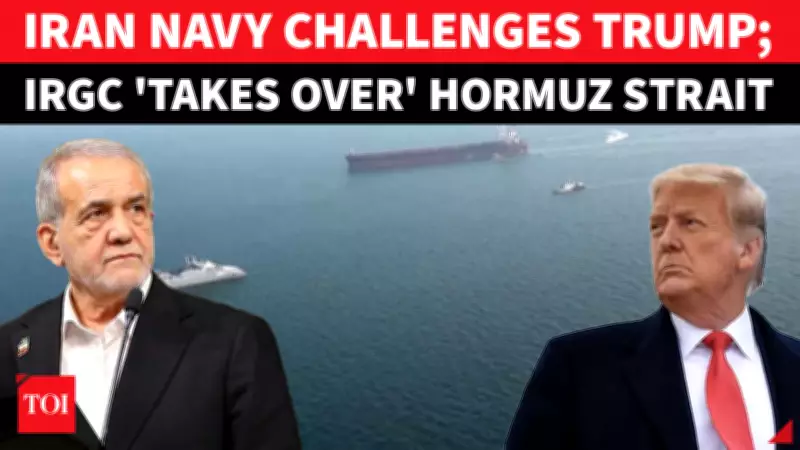
Iran's Revolutionary Guard Corps Announces Strikes on 10 Vessels in Hormuz Strait
In a significant escalation of maritime tensions, Iran's Islamic Revolutionary Guard Corps (IRGC) has declared it has achieved "full control" over the strategic Hormuz Strait, claiming to have targeted ten commercial ships for violating blockade orders. The announcement comes amid heightened regional instability and ongoing conflict involving Iranian forces.
Details of the IRGC's Maritime Operations
The IRGC, Iran's elite military force, stated that the vessels were struck after they failed to comply with naval blockade directives in the Hormuz Strait, a critical chokepoint for global oil shipments. While specific details about the ships' nationalities, cargo, or extent of damage remain undisclosed, the IRGC emphasized that the action demonstrates their operational dominance in the region's waterways.
This development follows a series of recent maritime incidents linked to Iran, including the sinking of an Iranian vessel near Sri Lankan waters after a suspected submarine attack. In that earlier event, at least 30 people were rescued by the Sri Lankan Navy off Galle coast, with over 100 individuals still missing, according to Reuters sources. Sri Lankan Foreign Minister Vijitha Herath has pledged appropriate action, though authorities have not confirmed the submarine's identity.

Broader Context of Regional Escalation
The IRGC's claims align with a pattern of aggressive posturing amid the Iran conflict. Recent reports have highlighted multiple attacks involving Iranian forces:
- Iranian missiles reportedly destroying U.S. radar and satellite equipment worth millions of dollars.
- Ballistic missile strikes targeting CENTCOM headquarters in Qatar, with Qatar confirming the attack but reporting no loss of life.
- Hezbollah joining Iran's retaliation efforts with missile and rocket attacks on Tel Aviv and northern Israel.
- Drone strikes on U.S. diplomatic facilities in Dubai and Saudi Arabia, including a CIA facility in Riyadh.
These incidents have sparked international concern, with NATO reportedly facing internal divisions over the conflict. French and other European leaders have criticized U.S. actions, while protests in NATO nations like Bulgaria demand the removal of U.S. planes, fearing escalation.
Implications for Global Maritime Security
The targeting of ships in the Hormuz Strait raises serious alarms for global trade and energy security. Approximately one-fifth of the world's oil passes through this narrow waterway, making any disruption potentially catastrophic for international markets. Maritime authorities and shipping companies are now on high alert, reassessing routes and security protocols in response to the IRGC's assertive stance.
Sri Lanka's response to the earlier vessel sinking underscores the broader regional impact, with countries in the Indian Ocean and beyond grappling with increased threats to naval and commercial shipping. The lack of confirmed details in both incidents—whether the submarine attack or the IRGC strikes—adds to the uncertainty, complicating diplomatic and military responses.
As tensions simmer, the IRGC's message of "full control" serves as a stark warning to adversaries, promising further actions if their blockade orders are disregarded. The situation remains fluid, with global observers closely monitoring for any escalation that could trigger wider conflict in an already volatile region.