

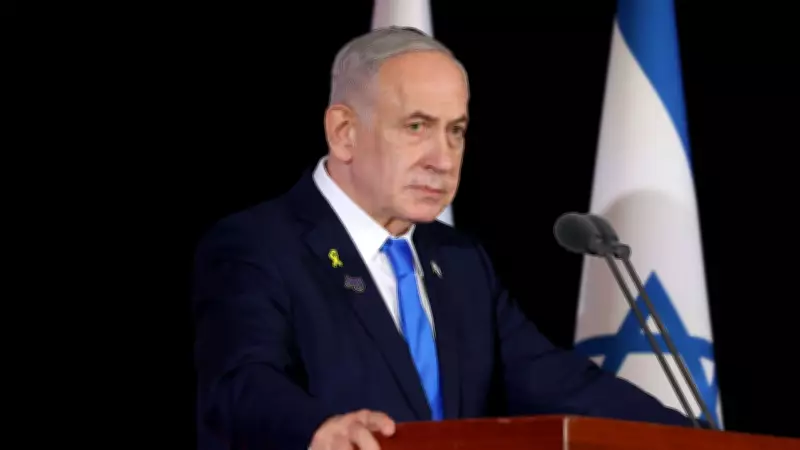
Israel Officially Denies Social Media Rumors of Netanyahu Assassination
Israel has categorically dismissed viral social media claims suggesting Prime Minister Benjamin Netanyahu was assassinated, with his office branding the reports as "fake news". This denial comes as tensions continue to escalate dramatically across the Middle East, particularly between Israel and Iran.
Origin of the False Claims and Official Response
The rumors began circulating online amid the ongoing and intense conflict between Israel and Iran. When directly questioned about these alarming posts, the Prime Minister's office provided a clear and unequivocal statement to Anadolu News.
"These are fake news; the Prime Minister is fine," the office declared, refuting claims that Netanyahu had been killed in retaliation for recent Israeli and American military strikes on Iranian targets.

Background: Escalating Regional Hostilities
The speculation emerged during a period of significantly heightened regional conflict that was triggered on February 28. On that date, Israel and the United States launched coordinated strikes on Iranian targets. These attacks reportedly resulted in the deaths of more than 1,200 people, including Iran's then-supreme leader, Ali Khamenei.
In response, Iran has retaliated with successive waves of drone and missile strikes across the region. These attacks have targeted Israel and several neighboring countries, including Jordan, Iraq, and various Gulf states. Tehran has stated that these operations are aimed at "US military assets" stationed in the Middle East.
Netanyahu's Direct Warning to Iran's New Leadership
Amid these escalating hostilities, Prime Minister Netanyahu issued a direct and stark warning to Iran's new supreme leader, Mojtaba Khamenei, who is the son and successor of the late Ali Khamenei. When asked whether Israel might attempt to target him similarly to other leaders allied with Iran, Netanyahu pointedly declined to rule out such a possibility.
"I wouldn't issue life insurance policies on any of the leaders of the terrorist organizations," Netanyahu stated. "This is their patron of terrorism. And I don't intend to provide an exact report here about what we are planning or what we are going to do."
Netanyahu further described Mojtaba Khamenei as a "puppet" of Iran's powerful Revolutionary Guard Corps, claiming he "cannot show his face in public."
A Shift in Strategic Balance and Military Posture
The Israeli leader also suggested that the latest developments have fundamentally altered the strategic balance in the region. "This is no longer the same Iran. This is no longer the same Middle East. And this is also not the same Israel," he asserted, outlining a new, more aggressive stance.
"We are not waiting, we are initiating, we are attacking. And we are doing so with a force the like of which has not been seen before," Netanyahu declared, emphasizing a proactive military approach.
Political Objectives and Hopes for Internal Change in Iran
Beyond immediate military actions, Netanyahu referenced a broader political objective. He indicated that Israel's military campaign could aim to create conditions conducive to political change within Iran itself, though he acknowledged that such an outcome ultimately rests with the Iranian populace.
"I have added another goal: to create the conditions for the Iranian people to overthrow this terrible tyrannical regime. To create conditions doesn't guarantee that it will happen… It's up to you," he said, addressing the Iranian people directly.
Netanyahu concluded with a proverb, "You can lead someone to water, but you can't make them drink," alluding to the uncertain prospect of a popular uprising against Iran's ruling establishment.






