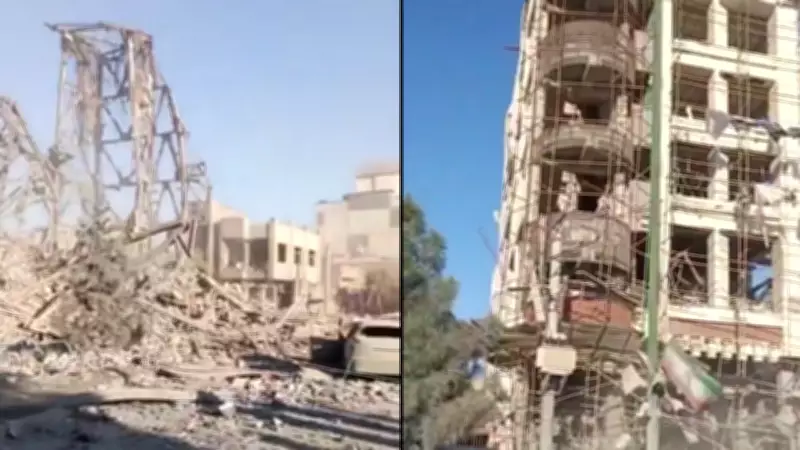
Israel Conducts Airstrike in Qom During Critical Iranian Leadership Transition
In a dramatic escalation of regional tensions, Israel carried out an airstrike on a building located in the Iranian city of Qom. The strike reportedly targeted a gathering of senior clerics from the Assembly of Experts, who had convened to initiate the crucial process of selecting a successor to the late Supreme Leader Ayatollah Ali Khamenei. This assembly, an 88-member clerical body constitutionally mandated to choose Iran's supreme leader, had not met for such a succession since it appointed Khamenei back in 1989, making this a rare and pivotal moment in Iranian history.
Conflicting Reports Emerge Regarding the Target and Casualties
An Israeli security official, as cited by ANI, indicated that it remains unclear how many of the Assembly's 88 members were present inside the building at the time of the strike. However, Iran's state news agency has strongly disputed this narrative, asserting that the targeted structure was merely an unused and dilapidated building, not a venue for any official meeting. This contradiction highlights the fog of war and the propaganda battle intensifying between the two nations.
Adding to the intrigue, Israel's Mossad intelligence service posted a provocative message in Persian on social media. The message declared that regardless of who is ultimately chosen to succeed Khamenei, "his fate has already been decided." It further emphasized that only the Iranian people themselves will ultimately determine their future leadership, a statement seen as a direct challenge to the clerical establishment.

Background: The Assassination and the Rush for a Successor
The immediate catalyst for this crisis was the assassination of Ayatollah Ali Khamenei on Saturday. Khamenei had led Iran since 1989, and his death triggered the urgent convening of the Assembly of Experts. Iran's leadership is now moving swiftly to fill the supreme leader position, marking only the second time since the 1979 Islamic Revolution that a new supreme leader is being chosen. The selection process is fraught with internal political divisions.
Potential successors reportedly range from hardliners advocating for continued confrontation with the West to reformist figures who support greater diplomatic engagement. Notably, Mojtaba Khamenei, the son of the slain supreme leader, has emerged as a front-runner under significant pressure from the powerful Islamic Revolutionary Guard Corps (IRGC).
Regional Conflict Intensifies with Broader Strikes and Casualties
Meanwhile, the hostilities between Israel and Iran have expanded beyond the Qom strike. Israel confirmed it carried out additional airstrikes on Tuesday, targeting Iranian missile launchers and a nuclear research facility. In retaliation, Iran launched strikes against Israel and across the Gulf region, targeting US diplomatic missions and causing significant disruptions to energy supplies and air travel.
The conflict, now four days old, has resulted in nearly 800 reported fatalities in Iran alone. US President Donald Trump, who noted the conflict could last several weeks or longer, stated that among the dead were individuals he had previously considered as potential future leaders of the country.
Explosions were also reported in Tehran and parts of Lebanon, where Israel said it struck Hezbollah militants in retaliation. The US Embassy in Saudi Arabia and the US Consulate in the United Arab Emirates were targeted in drone attacks. Iran has launched dozens of ballistic missiles toward Israel, with most being intercepted by defense systems. Despite these interceptions, Israeli authorities confirmed that 11 people have been killed since the fighting began.
This rapidly unfolding situation marks a severe escalation in the long-standing shadow war between Israel and Iran, now bursting into open conflict with profound implications for Middle Eastern stability and global geopolitics.