

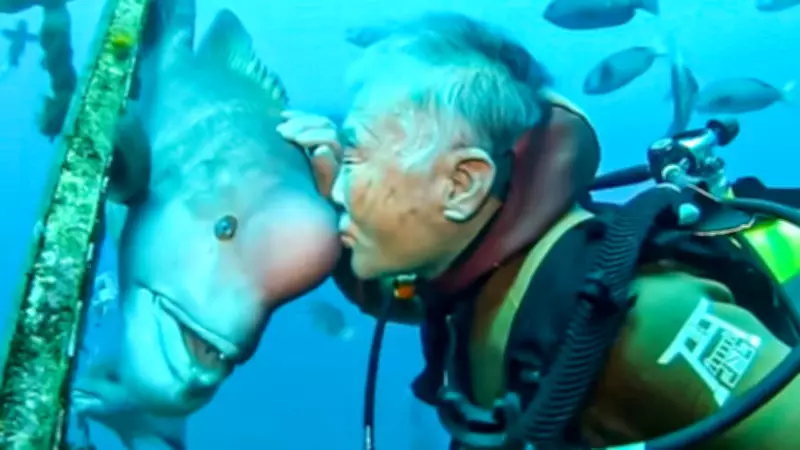
Japanese Diver's 30-Year Friendship with Wild Fish Captivates Global Audience
A remarkable story of interspecies connection has emerged from Japan's coastal waters, where a diver's three-decade-long relationship with a wild fish is drawing worldwide fascination. This unique case provides a rare, well-documented example of repeated recognition between a human and marine life over an extraordinary time span.
The Beginning of an Unlikely Bond
Hiroyuki Arakawa, a dedicated diver and caretaker of an underwater Shinto shrine gate near Tateyama in Chiba Prefecture, has been visiting the same coastal location for years as part of his routine maintenance duties. The extraordinary interaction began approximately thirty years ago when Arakawa encountered an injured Asian sheepshead wrasse during one of his dives.
Moved by the fish's condition, Arakawa began feeding the creature to aid its recovery. The wrasse, later affectionately named Yoriko, remained in the area and gradually started approaching the diver during subsequent visits. What began as a compassionate act evolved into a consistent pattern of recognition and interaction that has persisted for more than three decades.

A Decades-Long Relationship Defying Expectations
Unlike fleeting encounters or short-term conditioning often observed in human-animal interactions, this relationship has demonstrated remarkable longevity and consistency. Arakawa does not maintain a fixed schedule for his visits, yet Yoriko frequently appears during his dives, suggesting the fish recognizes the diver and anticipates his presence.
Documentary footage reveals the wrasse approaching Arakawa without displaying signs of distress, allowing unusually close proximity that is uncommon in wild fish without prior conditioning. In several instances, Yoriko has made gentle physical contact with the diver, behavior that further distinguishes this relationship from typical human-marine life interactions.
Arakawa continues to feed Yoriko during his visits, maintaining the pattern established when the fish was injured. This consistent interaction has created what appears to be a genuine bond between species that typically have minimal contact.
Scientific Perspectives on Fish Cognition and Recognition
Research conducted over the past decade has significantly reshaped scientific understanding of fish intelligence and cognitive capabilities. Studies now suggest that several fish species, including wrasses, possess abilities previously underestimated by the scientific community:
- Recognition of individual human faces
- Retention of learned information over extended periods
- Demonstration of problem-solving behavior
- Memory of spatial environments and social hierarchies
A groundbreaking 2016 study published in Scientific Reports, titled 'Archerfish can discriminate human faces,' found that archerfish could distinguish between different human faces with impressive accuracy. Additional research has confirmed that reef fish can remember complex spatial arrangements and maintain awareness of social structures within their environments.
Wrasses are considered among the more cognitively advanced fish species, with documented behaviors including tool use and cooperative interactions. Scientists note that such behavior often relates to associative learning, where animals recognize sources of food, safety, or other benefits through repeated positive experiences.
A Continuing Case Study in Animal Cognition
While the precise nature of Arakawa and Yoriko's interaction remains open to scientific interpretation, their remarkable story is frequently cited in discussions about animal cognition and interspecies recognition. This case represents an exceptional example of how long-term exposure, environmental familiarity, and consistent positive interactions can lead to stable behavioral patterns, even in species not traditionally associated with complex memory or recognition capabilities.

The relationship between the Japanese diver and the Asian sheepshead wrasse continues to capture global attention, offering valuable insights into the potential for meaningful connections between humans and marine life. As scientific understanding of fish intelligence evolves, cases like this provide compelling evidence that our underwater counterparts may be more perceptive and capable of forming bonds than previously imagined.





