

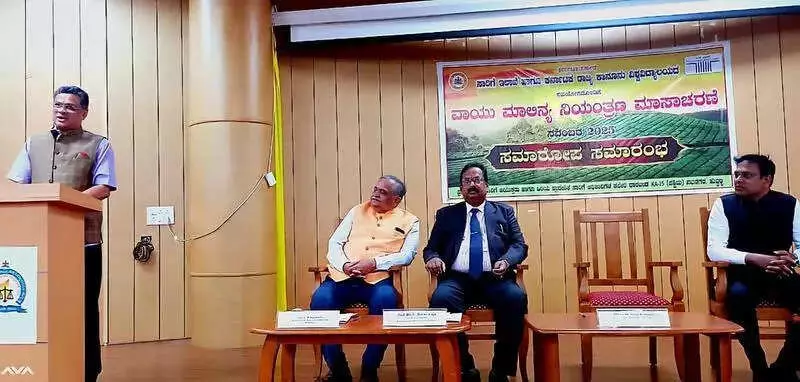
In a powerful call to action, Justice Krishna Dixit of the Orissa High Court emphasized the critical need to nurture concern and love for the environment in the minds of children. He was speaking at the valedictory function of the Air Pollution Control Awareness Month in Hubballi.
A Call for Environmental Responsibility
Justice Dixit inaugurated the event, organized jointly by the Transport Department and the Karnataka State Law University (KSLU) at the university's Navanagar auditorium. He stated that every individual must take responsibility for protecting the environment and cultivate a deep affection for every element within it. In a notable cultural observation, he mentioned that the Kannada language is older and stronger than Sanskrit and encouraged people to read Kannada literary works over English ones.
The Stark Reality of Pollution Highlighted
Drawing a vivid historical parallel, Justice Dixit recalled astronaut Neil Armstrong's moon landing in 1969. He pointed out Armstrong's remark that spotting New York City from space was easy due to the dense layer of smog, an early indicator of severe air pollution. The judge painted a grim picture of the current scenario, noting that even the water we drink and breast milk have been found to be polluted.

He elaborated on the daily hazards, stating that dense traffic poses significant problems for school children. Furthermore, environmental pollution acts as a major obstacle in building a strong and healthy society. Making a stark comparison, he said that while European rivers are clean, in our country, it is hard to even walk along the riverbanks due to the extent of pollution.
Experts Echo Concerns and Suggest Solutions
Other dignitaries at the event reinforced the urgency of the issue. Prof C Basavaraju, Vice-Chancellor of KSLU, warned that the global rise in environmental pollution is threatening the delicate interconnectedness between the environment and all living beings. He presented a tangible solution, adding that controlling vehicle emissions can reduce air pollution by 30-40%.
VD Kamaraddi, President of the Karnataka State Bar Council, stressed that environmental conservation is essential for human survival. He proposed a concrete measure: planting two trees for every vehicle and entrusting their maintenance to the forest department.
Deputy Transport Commissioner KT Halswamy highlighted a cultural contrast, noting that while common people in India own cars and bikes, other countries prioritize cycling and pollution control. "People there give more importance to environmental conservation," he said. Issuing a grave warning, he added, "In Delhi, people inhale polluted air, and in the future, we might have to carry oxygen cylinders."
Event Concludes with Awards and Recognition
Joint Transport Commissioner Siddappa Kallera mentioned that the Air Pollution Control Awareness Month is observed every November. The event also recognized winners of various competitions held during the campaign.
The winners of the essay competition were:
- First Prize: Pooja Wali
- Second Prize: Shilpa Chikkabendigeri
- Third Prize: Savita
In the art competition, the winners were:
- Sharanya G (First)
- Rubina (Second)
- Lakshmi Kubasad (Third)
The program was attended by officials from the transport department, university faculty, students, and members of the public, underscoring a collective concern for the pressing issue of environmental degradation.






