

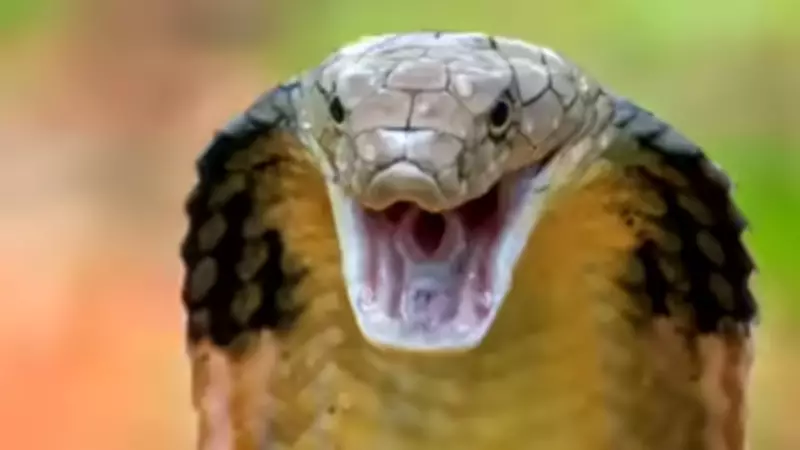
King Cobras Found Hitching Rides on India's Railway Network in Goa
When a king cobra appears in unexpected locations, the cause might not always be habitat destruction or climate shifts. According to groundbreaking research, the morning train could be the surprising culprit. A recent study published in the scientific journal 'Biotropica' reveals that India's extensive railway system may be inadvertently transporting these apex predators to areas far removed from their natural environments.
Research Uncovers Unusual Snake Transportation Method
Herpetologist Dikansh Parmar, affiliated with the Leibniz Institute for the Analysis of Biodiversity Change in Bonn, led a research team that analyzed over two decades of snake rescue records in Goa. Their study, titled 'Snakes on Trains: Railways May Sway Goa's King Cobra Distribution,' focused on the Western Ghats king cobra, a species endemic to the region.
The investigation uncovered startling findings: among 47 locations where king cobras were rescued, five were completely unsuitable habitats, all situated within a few hundred meters of railway tracks and stations. Most remarkably, one snake was discovered in the port city of Vasco, approximately 120 kilometers away by train from the rainy forest habitats these reptiles typically prefer.

How Snakes Board Trains and Why This Matters
Parmar theorizes that snakes may be entering train compartments seeking shelter or pursuing prey. "Rat-infested goods wagons make for particularly good hideouts," he explained, "because of the availability of prey." While this accidental rail transport might seem unusual, Parmar believes such incidents are likely underreported across India's vast railway network.
"One indication of this is the increased reporting in recent years of snakes on trains on social media platforms," Parmar noted, suggesting the phenomenon may be more widespread than documented.
Ecological Consequences of Accidental Wildlife Relocation
The implications of this unintentional transportation are significant for wildlife conservation. "Many snakes are highly adaptable, but king cobras have very specific habitat, prey and microclimatic needs," Parmar emphasized. "Being moved into unsuitable environments may significantly reduce their chances of survival."
Local snake rescuers in Goa confirm that various snake species—not just king cobras—have been rescued from locations adjacent to railway infrastructure. Amrut Singh from the Animal Rescue Squad in Bicholim recounted finding a pit viper inside a scooter parked near a railway station, illustrating how snakes can travel with transported vehicles.
Broader Pattern of Unintentional Wildlife Movement
Benhail Antao, honorary wildlife warden of the Goa forest department and host of 'Snakes SOS: Goa's Wildest' on NatGeo India, contextualized this phenomenon within broader transportation impacts. "Unintentional movement of wildlife has been happening since the dawn of transport via trains, ships and trucks," he observed.
Antao noted this affects multiple species: "We see it with reptiles, birds, frogs and lizards." He recalled an incident where a bamboo pit viper, which prefers cool hilly forest conditions, was found in humid Mapusa, likely transported there by fruit trucks.
"This is also not unique to India," Antao added. "Blind snakes and worm snakes that live in soil and feed on termites have been found transported with potted plants to the United Kingdom." Such accidental relocations pose risks to both species survival and ecological balance, with Antao noting that "a king cobra in Vasco cannot survive for long" in unsuitable conditions.
Scientific Implications for Species Distribution
Professor P Dennis Röder from LIB, who co-authored the research with Parmar, highlighted the broader scientific significance. "Artificial dispersal corridors created by human infrastructure may profoundly influence how species are reorganised across landscapes," he stated, suggesting that transportation networks might be reshaping wildlife distribution patterns in unexpected ways.

The Goa study provides compelling evidence that India's railway system, while crucial for human connectivity, may be creating unintended pathways for wildlife movement, with particular implications for specialized species like the king cobra that depend on specific environmental conditions.





