

Kolkata's Air Quality Crisis: Ranks 49th in India's Pollution Index
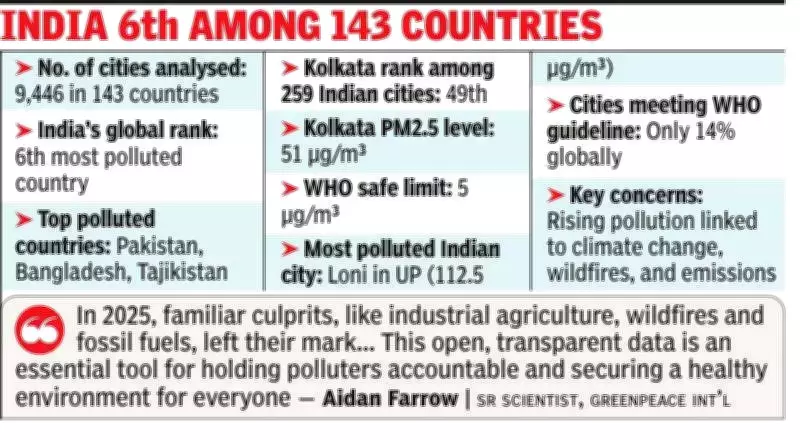
Kolkata has been placed 49th among 259 Indian cities in the IQAir 2025 World Air Quality Report, highlighting persistent and severe air pollution challenges across eastern India and the broader South Asian region. The report, released by the Swiss air quality technology organization IQAir, evaluates pollution based on annual average PM2.5 concentrations—fine particulate matter that can penetrate deep into lungs and the bloodstream, posing serious health risks.
India's Pollution Landscape: A Grim Reality
According to the report, Loni in Uttar Pradesh tops the list as India's most polluted city in 2025, with a PM2.5 concentration of 112.5 µg/m³. It is closely followed by Byrnihat in Assam at 101.1 µg/m³ and Delhi at 99.6 µg/m³, reinforcing a trend of extreme pollution in northern and north-eastern India. Kolkata, with an annual average PM2.5 concentration of approximately 51 µg/m³, falls into a category where pollution levels exceed the World Health Organization (WHO) guideline by more than 10 times. In the survey, Kolkata ranks 49th among the 50 most-polluted cities in India, performing better than only Delhi among mega cities.
Global and Regional Implications
The report analyzed air quality data from 9,446 cities across 143 countries, painting a broader picture of deteriorating air quality in South Asia. India ranked as the sixth most polluted country globally in 2025, with an average PM2.5 concentration of 48.9 µg/m³, trailing behind Pakistan, Bangladesh, Tajikistan, Chad, and the Democratic Republic of the Congo. Globally, the findings reveal a worrying stagnation in progress on air quality improvement. Only 14% of cities worldwide met the WHO's annual PM2.5 guideline in 2025, down from 17% the previous year, and 91% of countries exceeded safe limits.

Factors Driving Pollution and Expert Insights
Experts attribute the worsening air quality to a combination of factors, including industrial emissions, vehicular pollution, construction dust, and seasonal influences such as crop-burning and temperature inversions. Additionally, climate change-driven events like wildfires have played a significant role in elevating global pollution levels, with the report noting that wildfire emissions contributed substantially to atmospheric particulate matter. Aidan Farrow, a senior scientist at Greenpeace International, commented, "The World Air Quality Report reveals two competing realities: an air pollution crisis and the rise of communities, scientists, and data working to meet the challenge. In 2025, familiar culprits, like industrial agriculture, wildfires, and fossil fuels, left their mark in the data collated by IQAir worldwide. This open, transparent data is an essential tool for holding polluters accountable and securing a healthy environment for everyone."
Local Impact in Bengal and Kolkata Region
In Bengal and the Kolkata metropolitan region, several areas feature prominently in the pollution rankings. Madhyamgram is ranked seventh nationally with a PM2.5 level of 83.3 µg/m³, Barrackpore is 21st with 62.6 µg/m³, and Howrah is 30th with 55.1 µg/m³. These figures indicate that air pollution is not confined to Kolkata alone but is a regional issue affecting suburban and industrial zones alike, underscoring the widespread nature of the problem.
Challenges and Urgent Calls for Action
IQAir emphasized that a lack of comprehensive monitoring remains a critical barrier to tackling air pollution globally. Millions of people still lack access to real-time, localized air quality data, which limits both public awareness and effective policy responses. Despite some regional improvements, the survey highlights an urgent need for coordinated action. Experts recommend expanding air quality monitoring networks, transitioning to cleaner energy sources, and implementing stricter emission controls as key steps toward mitigating the crisis. The WHO recommends an annual average PM2.5 level of no more than 5 µg/m³, highlighting the severity of pollution exposure in urban India and the long road ahead for achieving safe air quality standards.






