Kolkata Records Third Worst PM2.5 Pollution Levels in January 2026
Kolkata has been identified as the third most polluted city in India for PM2.5 concentrations during January 2026, according to a comprehensive new analysis. The findings reveal a distressing pattern of air quality deterioration across West Bengal's urban landscape, with multiple cities failing to meet national safety standards.
Alarming Pollution Data from CREA's Monthly Snapshot
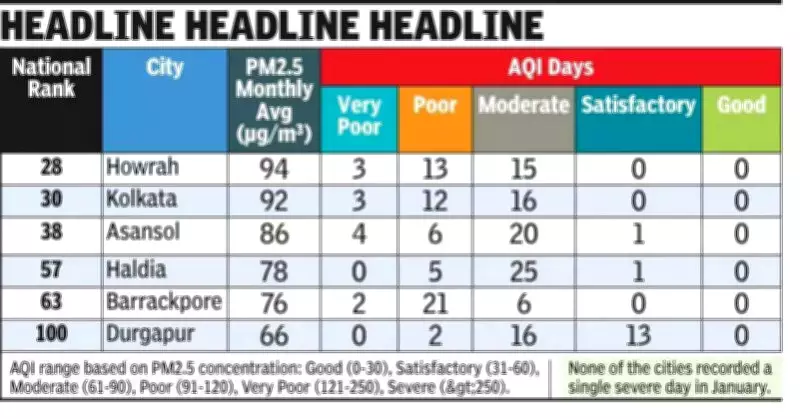
The Centre for Research on Energy and Clean Air (CREA) released its January 2026 Monthly Air Quality Snapshot, which placed Kolkata at the 30th position nationally with an average PM2.5 concentration of 92 micrograms per cubic metre. This measurement significantly exceeds India's National Ambient Air Quality Standards (NAAQS) limit of 60 µg/m³, highlighting a severe public health concern.
Neighboring Howrah performed even worse, ranking 28th nationally with an average PM2.5 level of 94 µg/m³. This data underscores the shared airshed challenges facing the entire Kolkata metropolitan region, where pollution doesn't respect municipal boundaries.

Widespread Air Quality Crisis Across West Bengal
The pollution crisis extends far beyond Kolkata's metropolitan area. Industrial and urban belts throughout West Bengal showed similar air quality stress during January 2026:
- Asansol, Durgapur, Barrackpore, and Haldia all surpassed the national PM2.5 standard
- Siliguri in north Bengal, while relatively cleaner than other cities, still exceeded the World Health Organisation's recommended daily safe guideline of 15 µg/m³
- Not a single Indian city complied with WHO guidelines during the entire month
Daily Air Quality Breakdown for Kolkata Residents
Kolkata residents endured particularly difficult air quality conditions throughout January 2026:
- Three days classified as "very poor" air quality
- Twelve days recorded as "poor" air quality
- Sixteen days were "moderate"
- No "good" or even "satisfactory" days were recorded throughout the entire month
Howrah experienced a similar distribution of air quality days, while Asansol recorded four "very poor" days—among the worst in the state. These categories correspond to India's Air Quality Index (AQI), which directly links higher PM2.5 levels to increased risks of respiratory and cardiovascular illnesses.
Expert Recommendations for National Air Quality Management
Manoj Kumar, India Analyst at CREA, emphasized the urgent need for policy intervention: "To mitigate this recurring and year-long pollution, the revision of the National Clean Air Programme (NCAP) presents a key opportunity to strengthen India's air quality management."
Kumar outlined several critical recommendations for the NCAP revision:
- Prioritizing PM2.5 and its precursor gases (SO2 and NO2) over PM10
- Revising the list of non-attainment cities based on current data
- Setting stricter emission standards for industries and power plants
- Adopting an airshed-based approach to address air pollution at a regional scale
The analysis reveals that nearly half of India's monitored cities failed to meet official pollution standards in January 2026, indicating a national air quality crisis that requires immediate and comprehensive policy responses.