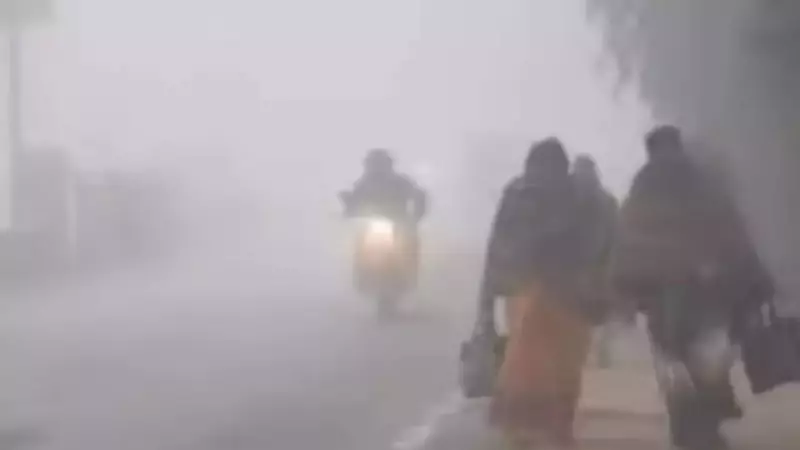
Kolkata ushered in the New Year with a thick blanket of hazardous air, as widespread midnight firecracker celebrations combined with harsh winter conditions to create a severe pollution crisis. The city's air quality index (AQI) plummeted into the 'poor' and 'very poor' categories, presenting a serious health hazard to its residents.
Winter Inversion Worsens Firecracker Impact
While the scale of fireworks was reportedly lower than during Diwali, environmental experts stated the impact on January 1 was far more severe. This was primarily due to the prevailing winter weather. The cold air leads to a phenomenon called thermal inversion, which acts like a lid over the city. It traps pollutants close to the ground by restricting vertical air movement and prevents their natural dispersal into the upper atmosphere.
A scientist from the West Bengal Pollution Control Board (WBPCB) issued a stark warning, calling firecracker revelry in winter "suicidal" for air quality. "Low ground temperature causes thermal inversion, suppressing vertical wind movement. Wind speed often drops below 2 metres per second, allowing pollutants to accumulate near the surface," the scientist explained.

Alarming AQI Readings Across Monitoring Stations
By noon on New Year's Day, the data from air quality monitoring stations painted a grim picture. Two stations entered the 'very poor' category (AQI 301–400), just one step away from 'severe'. The remaining five stations recorded air in the 'poor' range (AQI 201–300).
Jadavpur was the worst affected, hitting an AQI of 314. This alarming figure matched pollution levels seen in Delhi during its recent peak smog crisis. Salt Lake followed closely with an AQI of 308, while Victoria Memorial recorded 292, teetering on the edge of the 'very poor' threshold. The rapid deterioration was shocking; barely 24 hours earlier, Jadavpur and Salt Lake had AQI readings of 159 and 154 respectively, both in the 'moderate' range.
The only slight relief came from a breeze that helped disperse some pollutants, preventing the situation from turning even more critical.
Slow Recovery and Rampant Noise Pollution
Experts cautioned that with cold conditions expected to persist, recovery would be slow. Pollution from successive days is likely to pile up in the lower atmosphere, leading to a prolonged period of bad air. Environmentalists highlighted the serious risks to public health, especially for children, senior citizens, and those with respiratory problems. They stressed the urgent need for stricter enforcement of norms and greater public awareness during future celebrations.
The New Year's night was also marked by widespread violations of noise pollution norms, particularly in the first hour of 2024. Monitoring data revealed noise levels breaching 80 decibels in several residential and silence zones—nearly double the permissible night-time limits.
Jadavpur University, a designated silence zone, recorded noise as high as 84.1 dB. Flora Fountain in a residential area touched 81.5 dB shortly after midnight. Several other colleges and educational institutions, also classified as silence zones, reported levels between 70 and 80 dB. The permissible night-time limit is 45 dB for residential areas and 40 dB for silence zones.
Beyond firecrackers, the illegal use of loudspeakers without sound limiters and blaring DJ music added to the cacophony. In areas like Madhyamgram's Deshbandhunagar, complaints from residents like Suman Roy, who pleaded for relief for his elderly parents, were reportedly ignored.