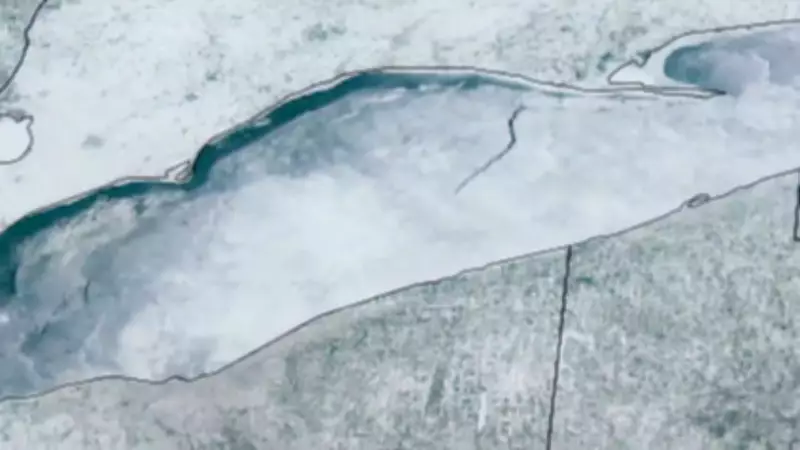
Massive Ice Crack on Lake Erie Stretches 80 Miles, Visible from Space
Lake Erie, one of North America's largest lakes, has stunned observers this week with the emergence of a colossal ice crack. This fissure spans over 80 miles and is so extensive that it can reportedly be seen from space. Residents along the north shore in Canada have spotted it extending all the way to Cleveland, Ohio, highlighting the sheer scale of this natural phenomenon.
How the Crack Formed and Expanded
The crack began to develop on Saturday, driven by powerful northerly winds that pushed ice southward. As the ice shifted, pressure built up until it finally snapped, creating a split more than 80 miles long. This event serves as a stark reminder that ice, regardless of its thickness, is never entirely safe. Even on days when the surface appears solid, thin spots or sudden cracks can emerge without warning. Experts confirm that this is precisely what is occurring on Lake Erie at present.
Satellite Images Reveal Near-Total Freeze with Growing Cracks
According to NOAA's Great Lakes Environmental Research Laboratory, approximately 95 percent of Lake Erie is currently frozen. However, the massive crack may continue to expand. Forecasters predict a slight rise in temperatures, which could weaken the ice further. Some meteorologists suggest that the likelihood of Lake Erie fully freezing over this winter is diminishing, as full freezing is a rare occurrence.

Historical Context and Safety Warnings
Lake Erie has only completely frozen over three times in modern history, with the most recent instance being 30 years ago in 1996. Typically, winters see ice coverage of 65 to 70 percent. In recent years, the lake has come close to full freezing in 2025, 2018, 2015, 2014, and 2011 but never achieved it entirely. Meteorologists are urgently warning locals to avoid walking, snowmobiling, or ice fishing on the frozen lake. Even thick ice can conceal weak spots, making it hazardous.
Aaron White from 10 WBNS emphasized that this event is a crucial reminder that ice safety is never guaranteed. People should remain cautious and vigilant, no matter how solid the ice appears. This warning extends beyond Lake Erie; for instance, New York's Hudson River also displayed ice from satellites after a recent cold snap, with temperatures dropping lower than parts of Antarctica and wind chills feeling as low as -14 degrees.
Causes and Implications of the 'Big Crack'
The primary cause of the big crack is wind pushing ice southward, which builds pressure that the frozen surface cannot always withstand. As ice shifts, cracks form, and satellite images vividly illustrate how massive these splits can become. Experts note that such cracking is normal when lakes approach near-total freeze, but it remains a dramatic spectacle to witness an 80-mile-long fissure. Most people never experience this scale firsthand, and even from space, it resembles a scar on the landscape.
This event underscores the dynamic and unpredictable nature of ice formations, serving as both a mesmerizing natural display and a critical safety alert for communities around the Great Lakes.