

From Forest Killer to Sustainable Resource: Lantana's Remarkable Transformation
Long before it earned its notorious reputation as a destructive force in India's forest ecosystems, the lantana camara plant arrived quietly on Indian soil during the colonial era. Originally introduced for shade provision and soil cover enhancement, colonial administrators had little awareness of the extensive environmental damage this species would eventually unleash across the country's diverse landscapes.
The Invasive Challenge and Creative Solution
Today, lantana camara stands widely recognized as one of India's most problematic invasive species, systematically choking native vegetation and significantly contributing to forest fire intensity through its dense growth patterns. Conservationists have appropriately labeled it a 'forest killer' for its devastating ecological impact. Across India's forested regions, enormous quantities of lantana biomass are routinely uprooted and discarded as waste material, with few sustainable disposal solutions available to forest management authorities.
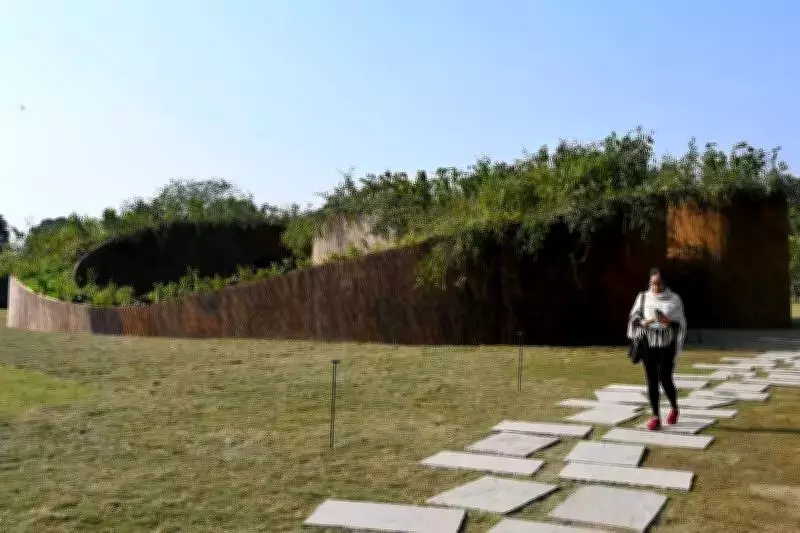
This February, that conventional perception is being dramatically transformed at Delhi's Sunder Nursery, where the invasive weed has been creatively reimagined as primary material for an innovative public ecological installation. As part of the Aranyani Pavilion exhibition, this groundbreaking installation utilizes specially treated lantana wood to demonstrate how invasive plant biomass can be effectively repurposed into durable, low-impact design elements. Open to public viewing until February 20th, the exhibition strategically positions lantana not merely as an environmental problem requiring elimination, but as a potential resource offering ecological and design possibilities.

Architectural Innovation and Symbolic Design
Right at the installation entrance, visitors encounter an inward-moving spiral structure meticulously constructed from upcycled lantana material, supported by complementary bamboo frameworks. As the pathway gradually narrows, external urban noise and chatter naturally fade, replaced by carefully curated forest soundscapes playing within the pavilion interior. Above this structure, a living canopy comprising more than forty native and indigenous plant species rests atop the framework, designed to grow and evolve over time. This thoughtful architectural approach allows invasive plant material and native species to coexist harmoniously, visually illustrating how destructive biomass can be creatively repurposed without causing additional harm to surrounding ecosystems.
At the spiritual heart of the pavilion rests a quiet, domed chamber housing an impressive stone shrine carved from a massive nine-tonne block of soapstone. This material was thoughtfully sourced from an off-cut at a quarry in Rajasthan's Bhilwara district, continuing the installation's theme of resourceful material utilization. Traditionally employed across cultures to mark sacred spaces, the soapstone element provides a grounding, anchoring presence within the overall installation.
Philosophical Dimensions and Visitor Engagement
According to student volunteers facilitating the exhibition, the spiral movement intentionally symbolizes an inward, contemplative journey, inviting visitors to pause and deeply reflect on their personal relationship with nature rather than merely passing through the space. "I maintain a very close connection with nature, which motivated my visit to experience this installation," shared Joginder Oberoi, an 80-year-old visitor who toured the pavilion in a wheelchair. "The concept demonstrates remarkable innovation and environmental consciousness."
The pavilion derives its name from Aranyani, the revered forest goddess prominently mentioned in ancient Rigvedic texts. "Our fundamental objective involves reconnecting people with natural environments by encouraging slower movement and inward contemplation," explained Alina, a dedicated student volunteer at the site, while elucidating the installation's symbolic elements to curious visitors.

Conservation Science Meets Creative Arts
The Aranyani Pavilion's inaugural edition, titled Sacred Nature, has been conceptually developed by conservation scientist and creative director Tara Lal. This interdisciplinary initiative successfully bridges conservation science, architectural design, and creative arts to renew and strengthen human connections with the natural world. The project draws significant inspiration from India's traditional sacred groves—community-protected forest spaces preserved for centuries through cultural practices and spiritual beliefs. India is believed to host over one lakh such sacred groves, many maintained through generations of cultural stewardship.
Informational panels strategically placed throughout the pavilion detail how lantana, originally introduced during colonial administration, has aggressively spread across India's diverse ecosystems. Current estimates suggest this invasive species has affected more than thirteen million hectares of forest land by systematically suppressing native plant growth. Rather than treating lantana exclusively as waste material requiring disposal, the installation explores how invasive biomass can be transformed into sustainable building resources with environmental benefits.
Beyond Installation: Educational Programming
Beyond functioning as an immersive walkthrough experience, the Sunder Nursery site will host an extensive program of panel discussions, expert talks, and live yoga sessions throughout the exhibition period. These conversations will focus specifically on India's evolving architectural ecosystem, addressing critical questions of place, material selection, and climate responsiveness. The programming will thoroughly examine what it means to build with greater attention to living systems and ecological sustainability.





