The Lonar Lake Emergency: A Geological Marvel Under Threat
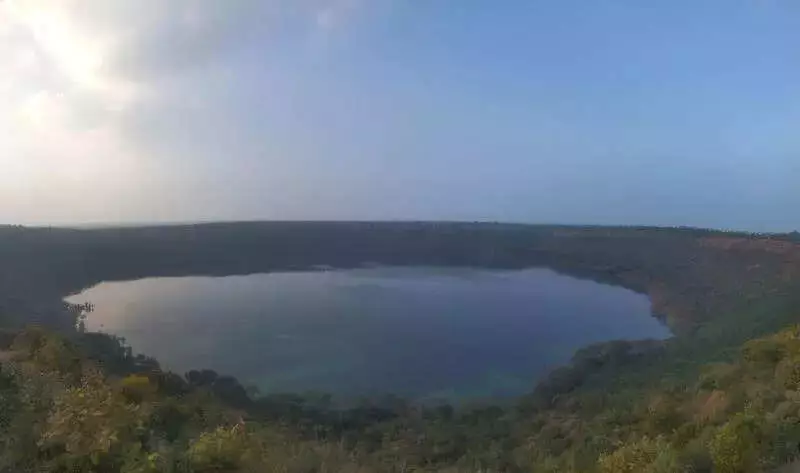
In the heart of Maharashtra's Buldhana district lies a geological wonder formed approximately 50,000 years ago—the Lonar Lake, India's only basaltic meteor impact crater. This extraordinary site has long served scientists as a rare terrestrial analog for studying Martian environments due to its unique characteristics. However, this natural monument now faces an unprecedented environmental crisis that threatens its very existence.
A Unique Ecosystem in Peril
Designated as a Ramsar wetland site, Lonar Lake has historically maintained extreme chemical conditions that created a world apart from typical freshwater bodies. With high salinity levels and an exceptionally alkaline pH of 11.5, the lake's waters were so caustic that no fish could survive within them. Instead, this harsh environment fostered a unique kingdom of specialized microorganisms and biodiversity found nowhere else on Earth.
The first signs of trouble emerged last year when, for the first time in recorded history, fish were spotted swimming in the lake's waters. What began as a scientific curiosity has rapidly escalated into a full-blown environmental emergency, prompting the Nagpur bench of the Bombay High Court to take suo motu notice of the situation. The court is now demanding answers about why one of India's most significant natural monuments is undergoing irreversible changes.

Visible Signs of Crisis
The physical evidence of this crisis is unmistakable to any visitor approaching the crater. Nine of the fifteen ancient temples that grace the shoreline—architectural relics from a medieval era—now stand partially or completely submerged. Forest officials who surveyed the site in November last year reported water merely lapping at the temple steps. Today, the rising waters threaten to completely submerge the idol of Kamalja Devi, the village deity whose temple has withstood centuries of history only to face inundation from 21st-century environmental shifts.
"It is heartbreaking," shared a local forest staff member. "The rains persisted from May until October last year, and for the first time, the deity herself is in danger of being lost to the rising tide. The lake is expanding, but in doing so, it is losing its very essence."
The Complex Causes Behind the Flooding
Contrary to initial assumptions, this flooding in a closed-basin lake cannot be attributed solely to heavy rainfall. Instead, experts describe a complex "perfect storm" of human interventions that have fundamentally altered the crater's natural hydrology. Veteran hydrogeologist Ashok Tejankar, former pro-vice chancellor of Dr. Babasaheb Ambedkar Marathwada University, recently conducted a comprehensive survey of the 1,800-meter-diameter crater.
His findings reveal that the lake level has risen by a staggering 20 feet—a dramatic change driven by an inadvertent breach of the crater's natural plumbing system. While the region has indeed experienced higher-than-average rainfall over the past two years, Tejankar's research points to a more permanent and troubling problem: the proliferation of deep borewells throughout the surrounding catchment area.
"Farmers in the surrounding catchment area have drilled borewells reaching depths of 600–700 feet," explained Tejankar. "These wells have punctured the basaltic rock layers that were once impermeable. By piercing these deep aquifers, they have effectively activated a massive underground drainage system that now funnels groundwater directly into the crater."
Alarming Hydrological Changes
The numbers tell a concerning story. Historically, only two freshwater springs—Dhar (Gomukh) and Sitanahani—fed the lake with minimal water input. Today, two additional springs named Ram Gaya and Papareshwar have begun flowing with such intensity that their combined discharge equals a 10-horsepower pump operating continuously around the clock.
The scientific consequences of this freshwater influx are catastrophic. As groundwater slowly percolates through the rock formations and enters the lake, it dilutes the concentrated salts and minerals that created Lonar's unique chemistry. The pH level has already plummeted from 11.5 to approximately 8.5—a dramatic shift toward neutrality.

"A pH of 8.5 approaches neutral conditions," noted Tejankar. "This dilution erases the very characteristics that make Lonar unique. We're witnessing not merely a change in water level but a fundamental transformation in chemistry that will trigger a domino effect across the specialized flora, fauna, and microorganisms that have evolved here over fifty millennia."
Paradox of Scarcity Amid Abundance
In a cruel paradox, while the lake overflows with freshwater, Lonar village—perched precariously on the crater's edge—suffers from severe water scarcity. The town receives municipal water only once per month and remains desperately dependent on water tankers and the very borewells that are contributing to the crater's inundation.
Tejankar has proposed a dual-purpose solution to Buldhana MP Prataprao Jadhav. His plan involves intercepting the spring water at the bedrock level and pumping it out of the crater. "After appropriate purification, this water could serve as a domestic supply for Lonar town," he suggested. "This approach would provide sustainable water access for villagers while simultaneously lowering the lake level to protect both the ancient temples and the unique ecosystem."
Inadequate Protection and Conservation Challenges
Despite its designation as a Ramsar site, Lonar suffers from fragmented and insufficient protection measures. Atul Jethe, head of the geography department at CT Bora College, revealed that approximately 40% of Lonar village is constructed directly on the "ejecta blanket"—the debris field created by the original meteor impact.
"We have failed to recognize the holistic importance of this site," Jethe argued. "In the United States, the Barringer Crater receives meticulous protection. At Lonar, we have permitted roads, agriculture, fertilizers, and pesticides to encroach upon the ejecta zone. Each new road construction or field cultivation on the crater rim further damages this fragile ecosystem."
The government's attempt to address these issues through acquisition of 86 hectares of land for research and conservation has stalled due to local resistance. Farmers, fearing loss of livelihood, have voiced strong objections. "The government seeks our land but offers no viable alternatives," expressed one farmer. "Without our agricultural fields, how will we sustain ourselves and our families?"
Disconnect Between Aspiration and Reality
While the Maharashtra government has long advocated for UNESCO World Heritage status for Lonar, the ground reality remains far removed from international conservation standards. Basic infrastructure—from public sanitation facilities to scientific interpretation centers—remains woefully inadequate.
Currently, the forest department awaits a detailed report from groundwater surveys and development agencies. Chetan Rathore, assistant conservator of forest, acknowledged that while the department explores methods to reduce water levels, they face constraints imposed by the strict regulations of the Wildlife Protection Act.
The Lonar Lake crisis represents more than an environmental concern—it embodies the complex intersection of geological preservation, ecological balance, agricultural needs, and community livelihoods. As this 50,000-year-old marvel faces unprecedented threats, coordinated action and sustainable solutions become increasingly urgent to preserve this unique piece of India's natural heritage for future generations.