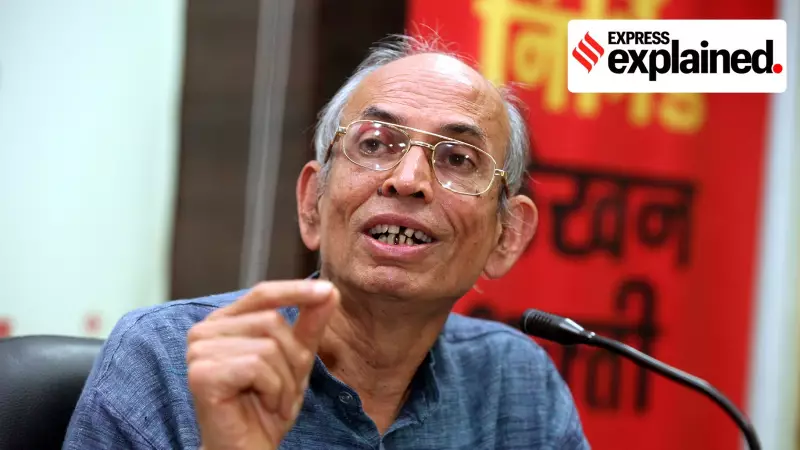
The passing of eminent ecologist Madhav Gadgil at 83 marks the end of an era for Indian environmentalism. His most enduring, yet contentious, legacy remains the seminal report of the Western Ghats Ecology Expert Panel (WGEEP), a document rejected by the government but one whose recommendations echo with every ecological disaster in the fragile mountain range.
The Seminal Report and Its Radical Vision
In March 2010, the Union Ministry of Environment and Forests constituted the WGEEP under Gadgil's chairmanship. The trigger was a meeting of the Save Western Ghats movement in the Nilgiris, attended by then Environment Minister Jairam Ramesh. The panel's mandate was clear: assess the ecology of the Ghats, demarcate sensitive areas, and recommend measures for conservation and sustainable development.
After extensive ground consultations, the Gadgil panel delivered a bold prescription in August 2011. It designated the entire 1,29,037 square kilometre span of the Western Ghats as an Ecologically Sensitive Area (ESA). This globally recognised biodiversity hotspot, often called the water tower of peninsular India for being the origin of rivers like Cauvery and Godavari, was to be protected under a three-tier zoning system.

The recommendations were comprehensive and strict. They included a prohibition on new mining licenses, a phase-out of existing mines within five years in the most sensitive zones, and a ban on new genetically modified crops. The report also advised against new major roads, railway lines, and the creation of special economic zones or hill stations in critical areas.
Central to the plan was the proposed creation of a 24-member Western Ghats Ecology Authority (WGEA), a statutory, multi-state body to regulate activities across the six states: Gujarat, Goa, Maharashtra, Karnataka, Kerala, and Tamil Nadu.
Political Opposition and the Kasturirangan Review
The report faced immediate and fierce political opposition. The UPA government, initially under Jairam Ramesh and later Jayanthi Natarajan, withheld the report from the public. It was only released in May 2012 after orders from the Chief Information Commissioner and the Delhi High Court, following appeals by environmentalists using the Right to Information Act.
State governments, particularly Kerala and Maharashtra, led the charge against it. Kerala argued that classifying large tracts of Idukki and Wayanad as ESA would devastate local economies dependent on cash crops. The state's then Finance Minister, KM Mani, claimed it would make agriculture and human activity impossible, a sentiment echoed by the Catholic Church. Maharashtra objected to the overarching WGEA, seeing it as a parallel authority that would undermine existing state agencies.
Bowing to this pressure, the Environment Ministry formed a High-Level Working Group under space scientist K Kasturirangan in 2012 to re-examine the recommendations. The Kasturirangan panel's 2013 report significantly diluted the Gadgil plan. It proposed demarcating only 56,825 square kilometres (about 37% of the Gadgil-recommended area) as ESA. While it maintained restrictions on polluting industries and mining, it identified specific villages as sensitive, moving away from the blanket protection model.
An Unfinished Legacy and Enduring Relevance
To this day, a consensus on the final notification of Ecologically Sensitive Areas in the Western Ghats remains elusive. The Centre has issued draft notifications six times, the latest in August 2024, but agreement with the states is pending. An expert committee under former Director General of Forests Sanjay Kumar is currently working to finalise the matter.
Despite its official rejection, the Gadgil report has never faded into obscurity. Its recommendations are routinely invoked by scientists, activists, and media whenever landslides, floods, or other ecological crises hit the Western Ghats region. Gadgil himself continued to champion the cause, arguing for inclusive development through Gram Sabhas to replace what he termed "exclusionary development and conservation."

Madhav Gadgil's work established a foundational ecological conscience for India's development discourse. The report stands as a testament to a vision where environmental sensitivity is not an obstacle, but a prerequisite for sustainable survival. As the debate over the fragile mountains continues, his warnings against mindless development serve as a critical, and increasingly urgent, guidepost for the future.