Maharashtra Government Launches Major Crackdown on Construction Pollution in Mumbai
In a decisive move to combat deteriorating air quality, the Maharashtra government has initiated a sweeping enforcement campaign targeting construction activities across Mumbai. Environment Minister Pankaja Munde disclosed to the state legislative assembly that authorities have issued stop-work notices to more than 1,000 construction sites for violating environmental regulations.
Widespread Enforcement Against Pollution Violations
Presenting comprehensive data from October 2025 through January 2026, Minister Munde detailed the scale of the ongoing "clean air" initiative. During this four-month period, regulatory bodies served 1,047 stop-work notices alongside 1,981 show-cause notices to construction projects failing to comply with dust mitigation and pollution control guidelines.
The enforcement action has impacted a substantial majority of active construction projects in India's financial capital. Of the 2,224 active construction sites currently operating in Mumbai, approximately 88%—amounting to 1,952 projects—have faced regulatory scrutiny and penalties for environmental violations.

Technology-Driven Monitoring and Strict Penalty Structure
The government has implemented a technology-focused approach to pollution monitoring, requiring construction sites to install low-cost air quality sensors. While 1,952 projects have complied with this mandate, the remaining sites have faced severe consequences for non-compliance.
"We are following a strict escalation matrix for violators," Minister Munde explained in her written reply regarding air quality index levels. "Construction projects failing to adhere to dust-mitigation guidelines are first given a formal intimation, followed by a show-cause notice, and then a stop-work order if they remain non-compliant."
The enforcement reached a peak on January 16 alone, when authorities ordered 678 projects to immediately halt operations for failing to install the mandatory air quality monitoring sensors. This single-day action underscores the government's determination to implement technology-driven pollution source monitoring across the construction sector.
Air Quality Assessment and Public Health Reassurance
Despite the widespread enforcement actions, Minister Munde asserted that Mumbai's air quality has largely remained within acceptable parameters. According to her statement, air quality index readings have consistently fallen within the 'satisfactory' (51–100) and 'moderate' (101–200) categories during the monitoring period.
The minister specifically refuted allegations of a public health crisis stemming from air pollution fluctuations. She cited official reports from both the Brihanmumbai Municipal Corporation (BMC) and Navi Mumbai Municipal Corporation (NMMC) indicating no documented adverse health impacts among vulnerable population groups, including children and senior citizens, despite periodic air quality variations.
Comprehensive Pollution Control Measures
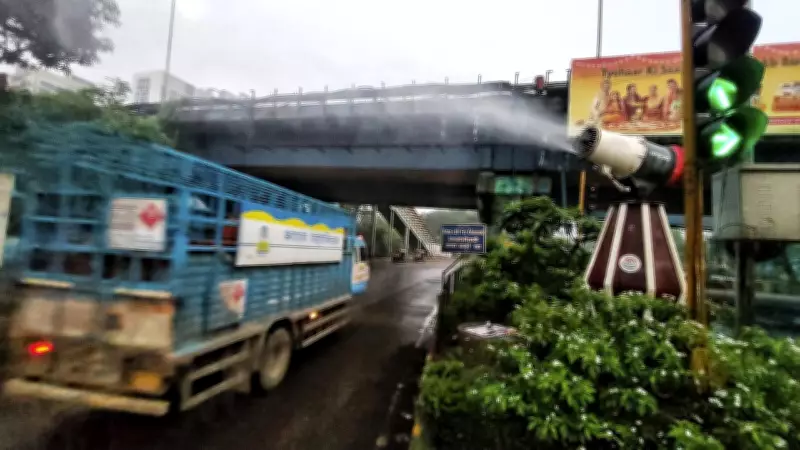
Beyond construction site enforcement, authorities have implemented multiple complementary strategies to address Mumbai's persistent dust problem. The BMC has deployed 126 water tankers and 25 misting machines across the city, collectively washing over 14,408 kilometres of roads to suppress airborne particulate matter.
Simultaneously, the municipal corporation's 25 ward-level flying squads have intensified efforts to curb illegal debris transport. During the four-month enforcement period, these teams collected fines exceeding Rs 1.21 lakh from violators transporting construction materials without proper dust containment measures.
The coordinated enforcement campaign represents one of the most comprehensive air pollution control initiatives undertaken in Mumbai's recent history, combining regulatory action, technological monitoring, and infrastructure-based mitigation strategies to address multiple pollution sources simultaneously.