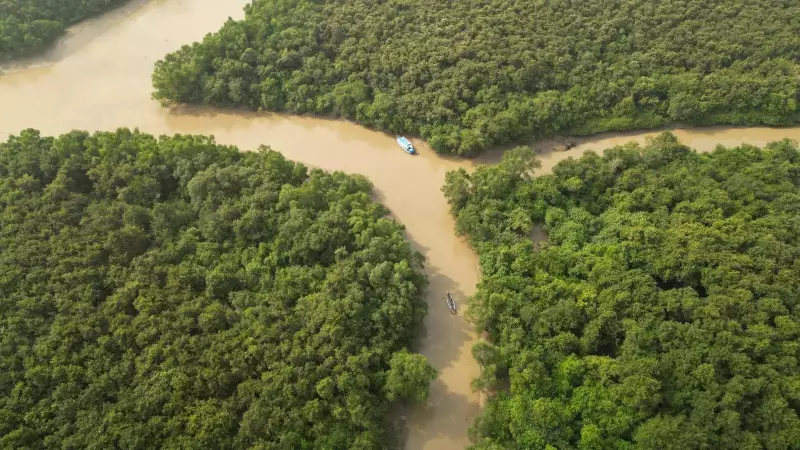
A day-long Mangrove Festival, known as Hental Mohostava, was celebrated with fervor at Ramanagar inside Odisha's Bhitarkanika National Park on Saturday. The event was jointly organized by the Gahirmatha Marine Turtles and Mangrove Conservation Society (GMTMCS) and the state forest department, drawing locals, students, and officials to underscore the critical importance of mangrove ecosystems.
Bhitarkanika: A Ramsar Site and Natural Guardian
Inaugurating the festival, Suvendu Prasad Behera, the Divisional Forest Officer (DFO) of Nabarangpur, highlighted the park's prestigious status as a Ramsar site. He detailed how the mangrove forests serve as a formidable natural shield, protecting coastal villages from cyclonic devastation. "Many people perished in the seaside villages in Kendrapada and Jagatsinghpur districts on Oct 29, 1999, in the super cyclone. But the mangrove forest-covered villages were not affected, as mangrove trees acted as barriers," Behera stated.
He further described the park as a biodiversity hotspot, home to spotted deer, saltwater crocodiles, water monitors, pythons, sambars, and large congregations of migratory birds in winter. The mesmerizing beauty of its lush green forests and water bodies, he noted, attracts travelers from across India and the world.

Crackdown on Illegal Shrimp Farms and Restoration Efforts
Forest Range Officer of Mahakalapada, Santanu Kumar Dalei, outlined the department's aggressive stance against environmental violations. "We, under police protection, demolished illegal shrimp farms over forest and revenue land recently. We will demolish the remaining ones too," he asserted. These farms, operating in violation of Coastal Regulation Zone norms and Supreme Court rulings, pose a direct threat to mangroves.
Dalei explained the dual menace of these farms: they not only encroach on forest land but also severely pollute the environment by dumping effluents into rivers and ponds and contaminating groundwater. As a corrective measure, the department has begun planting mangrove saplings on dismantled farm sites to restore the ecology. He also mentioned the initiation of the MISHTI (Mangrove Initiative for Shoreline Habitats and Tangible Incomes) programme in 2023-24, funded by CAMPA, to restore degraded mangroves.
Adding context, Dalei recalled that a decade ago, the Union Environment Ministry declared 192 villages around Bhitarkanika as eco-sensitive zones to prevent ecological damage from development activities around India's second-largest mangrove forest.
Community Calls for Sustained Action and Awareness
GMTMCS secretary Hemant Kumar Rout addressed the gathering, pointing to the high vulnerability of Odisha's coast to natural and man-made disasters. He expressed frustration over the lack of implementation of post-disaster committee reports, stating that even decades after the 1999 super cyclone, coastal communities continue to suffer due to inaction.
Environmentalist Suvranshu Das elaborated on the multifaceted benefits of mangroves. Beyond being a cyclone barrier, they stabilize shorelines, provide nesting grounds for terrestrial and aquatic species, and boost estuarine fisheries. They also yield resources like timber, firewood, honey, and medicines, forming the economic backbone for many locals who are now uniting to protect the forests from encroachers.
The festival successfully served as a platform to blend celebration with conservation messaging, engaging schoolchildren, college students, and panchayat members in the mission to protect Bhitarkanika's invaluable green guardians.