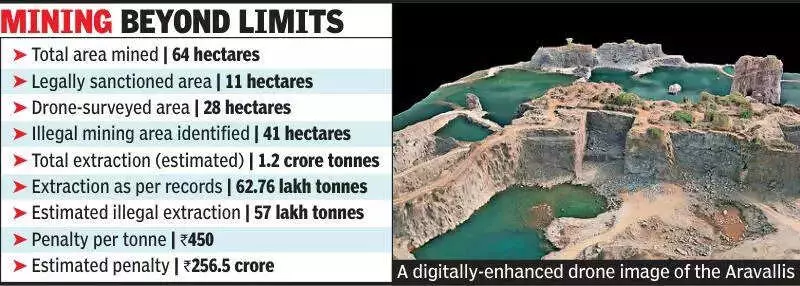
A shocking drone-based investigation has laid bare the systematic and large-scale destruction of the Aravalli range near Bhilwara in Rajasthan, revealing illegal mining operations far exceeding legally sanctioned limits. The volumetric survey exposes a massive gap between official records and the grim reality on the ground, pointing to sustained environmental plunder.
Drone Data Reveals Staggering Scale of Violations
The focused survey, conducted in the Samodi and Pansal Dang areas located just 15 kilometres from the Bhilwara district headquarters, found mining activity sprawled across nearly 64 hectares. Shockingly, only 11 hectares are legally permitted under valid mining leases. Mining expert and whistleblower Pradeep Singh, whose team conducted the assessment, stated that their drone analysis of 28 hectares found permissions for merely five hectares. "Mining expanded illegally into the remaining 22 hectares, indicating sustained violations rather than isolated breaches," Singh emphasized.
First Pit: Official Data vs. Ground Reality
The discrepancies are staggering in their detail. In the first pit area, leases were sanctioned for a combined area of two hectares. However, drone imagery shows mining operations extended over nearly nine hectares. While government records show extraction of 24.66 lakh tonnes of chhaja stone, the volumetric analysis estimates the actual mined quantity at approximately 51.9 lakh tonnes. This translates to illegal mining of around 27.24 lakh tonnes from this single zone.

Second Pit: An Even Larger Environmental Crime
The situation in the second pit area is even more severe. Here, leases were approved for three hectares, but mining activity was discovered spread over a vast 19 hectares. Official figures note extraction of about 38.09 lakh tonnes, but the drone survey calculates the total extraction to be close to 67.5 lakh tonnes. This points to illegal removal of nearly 29.41 lakh tonnes of stone.
Massive Financial Fraud and Environmental Cost
Combined, the two pit areas show extraction of nearly 1.2 crore tonnes of stone, while official records account for only 62.76 lakh tonnes. "This gap of roughly 57 lakh tonnes reflects unauthorised mining on a massive scale," said environmentalist Kishore Kumawat. He highlighted the financial implications, noting that at a royalty rate of Rs 45 per tonne, mining rules prescribe a penalty of ten times the royalty, or Rs 450 per tonne. Based on this, the potential penalty amounts to nearly Rs 256.5 crore for the illegally mined material.
Adding to the gravity of the situation, the survey notes that illegal mining activity allegedly continues daily after 7 pm, under the cover of darkness. When confronted with these findings, a senior mining official stated, "The matter was brought to our notice and it is being examined." The revelations underscore a critical failure in monitoring and enforcement, raising serious questions about the protection of the ecologically fragile Aravalli range.