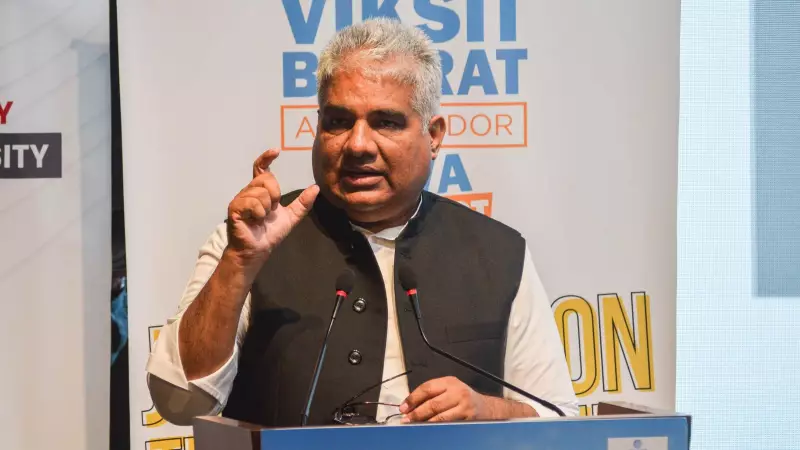
Union Environment Minister Bhupender Yadav has called for India's wildlife conservation model to be firmly rooted in science and international cooperation. The minister made these remarks while chairing a high-level joint meeting of the National Tiger Conservation Authority (NTCA) and the Project Elephant Steering Committee at the Sundarbans Tiger Reserve on Sunday.
Launch of Tiger Census and Science-Led Strategy
The sixth cycle of the All India Tiger Estimation was officially launched at the meeting, with ground surveys having commenced last month. Minister Yadav emphasized that managing India's rich biodiversity requires a science-based approach and collaboration with global partners. He cited the involvement of delegations from South Africa, Namibia, and Botswana in the cheetah reintroduction program as a prime example of such international synergy.
To tackle the growing issue of human-wildlife conflict, the minister unveiled a three-pronged strategy. A key component is the launch of a new specialized initiative named 'Management of Tigers Outside Tiger Reserves.' The meeting also reviewed persistent challenges, including staff shortages, financial limitations, and the pressing need to control invasive species damaging natural habitats.
Focus on Elephant Conservation and Tragic Assam Incident
On the elephant conservation front, the committee assessed the progress of the All-India Synchronized Elephant Estimation and DNA profiling for captive elephants. Discussions zeroed in on the Nilgiri and Ripu–Chirang Elephant Reserves, with a renewed focus on evaluating corridors and conflict zones in the Bandhavgarh region.
Addressing a recent tragedy, Minister Yadav informed the media that the Centre has sought a detailed report from the Assam government regarding the death of elephants in Hojai district. Seven elephants were killed after a herd was struck by the Sairang-New Delhi Rajdhani Express early Saturday, with a calf later succumbing to its injuries. Railway authorities have been directed to coordinate with state forest departments to monitor elephant movement near tracks.
Yadav highlighted nationwide efforts to prevent such conflicts, noting that 1,100 elephant accident zones have been identified across the country. District magistrates have been instructed to keep forest departments informed about elephant movements along highways.
Funding, Tourism, and Key Decisions Ratified
The minister provided insights into conservation funding, revealing that Rs 112 crore for tiger projects and Rs 344 crore for elephant projects were allocated to the Sundarbans over the past five years, though significant portions remain unutilized. He contrasted the annual tourist footfall of 9.5 lakh in the Sundarbans with the revenue of Rs 18-19 lakh at Ranthambore tiger reserve, urging better projection of the Sundarbans' 2,500 sq km biodiversity-rich zone.
The high-level meeting ratified several decisions from NTCA's technical committee, including:
- Approval of tiger conservation plans.
- Extension and expansion of Project Cheetah.
- Plans for tiger translocation and augmenting prey base.
- Landscape management planning and carnivore health training.
Updates were shared on expanding Project Cheetah to Gandhisagar Wildlife Sanctuary and Gujarat's Banni Grassland. Preparations for the proposed Global Big Cat Summit were also reviewed. The session concluded with the release of six publications, including the STRIPES journal and a manual on captive elephant management best practices. Minister Yadav reiterated the government's commitment to a community-centric approach, ensuring local populations are integral to long-term conservation goals.