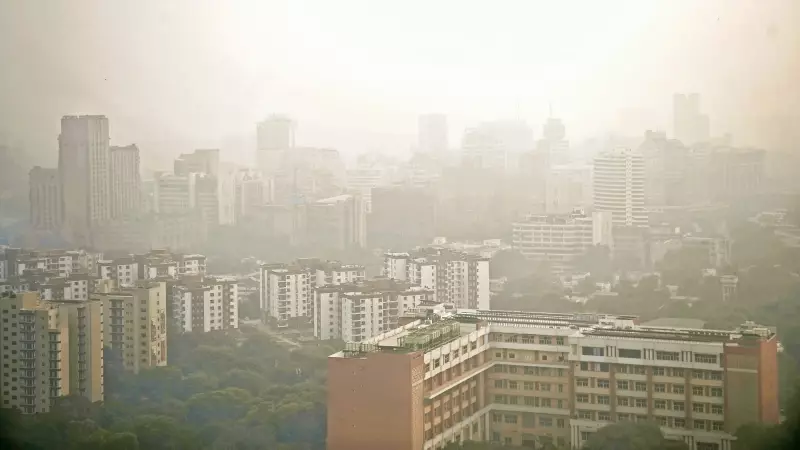
A recent analysis of air quality data for the year 2025 has painted a grim picture for the National Capital Region (NCR). The assessment, released by the Centre for Research on Energy and Clean Air (CREA), found that a majority of cities in the NCR failed to meet India's prescribed annual standards for PM2.5 pollution.
Delhi Tops the Chart as Most Polluted Metro
The report, based on data from the Central Pollution Control Board (CPCB) until December 30, 2025, identified Delhi as the most polluted city not just within the NCR, but among all of India's major metropolitan areas. Delhi's annual average Air Quality Index (AQI) stood at 201, categorizing it as 'Poor'. Alarmingly, the capital did not record a single day with 'Good' air quality throughout the entire year.
Among the 29 NCR cities studied, only 14 managed to record more than 75% of the required PM2.5 data. Notably, all 15 cities with insufficient data coverage were located in the state of Haryana, highlighting a significant gap in consistent monitoring. From the cities with adequate data, Delhi recorded the highest pollution levels, followed closely by Ghaziabad and Noida.

Widespread Breach of National Standards
The findings show a widespread non-compliance with the National Ambient Air Quality Standards (NAAQS). Except for Bharatpur and Alwar in Rajasthan, every other NCR city with sufficient data exceeded the annual PM2.5 limit. Ghaziabad earned the dubious distinction of recording the highest number of days where the daily PM2.5 limit was breached.
Within Delhi, the situation was uniformly poor. Every single monitoring station in the city exceeded the annual PM2.5 standard, with concentrations at each station being at least 1.8 times higher than the permissible limit. Jahangirpuri emerged as the most polluted monitoring location in the capital.
A Mixed Bag of Trends
The assessment revealed some contrasting trends. While Delhi's annual average PM2.5 concentration showed a decline compared to 2024, the average for the critical pollution season between October and December 2025 actually saw a slight increase. Furthermore, PM2.5 levels in the months of April, August, and December were higher than the corresponding months in the previous year.
A detailed look at Delhi's AQI breakdown for 2025 shows the city experienced 79 'Satisfactory' days, 121 'Moderate' days, 86 'Poor' days, 71 'Very Poor' days, and 8 'Severe' days. The number of 'Satisfactory' days increased from 66 in 2024 to 79 in 2025, with most of these occurring during June and July. However, CREA notes that this improvement only led to a marginal decline in the overall annual average AQI, indicating that the core pollution challenge remains largely unaddressed.
The report underscores the persistent and severe air quality crisis in northern India, calling for more robust data collection, especially in Haryana, and intensified, year-round action to tackle the sources of pollution beyond seasonal measures.