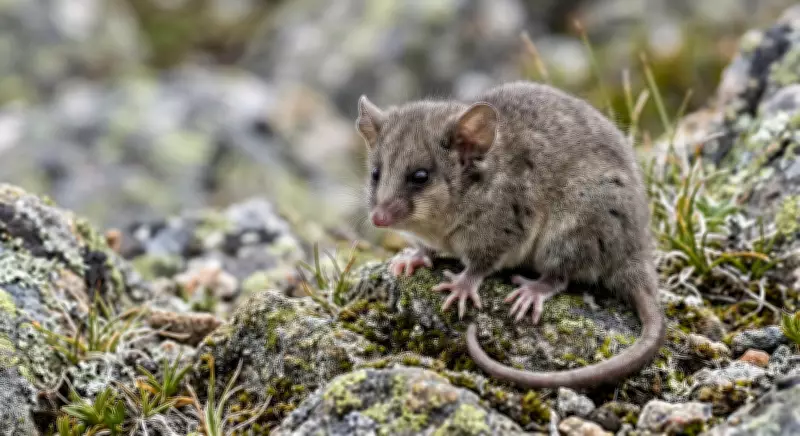
Imagine an animal that weighs about as much as a golf ball, sleeps for seven months at a time beneath a blanket of snow, and has somehow survived ice ages, mass extinctions, and continental drift. That is the mountain pygmy possum, and it is now losing a battle it never wanted to fight.
Fewer than 2,000 of these palm-sized marsupials remain in the wild, in three isolated populations in the Australian Alps. They live only in high-mountain sites, tucked into rock crevices in places most people will never visit. As the planet warms, those mountain peaks are becoming less hospitable.
Multiple Threats Converge
It is not just the temperature. The possums rely on snow for insulation during hibernation. Feral cats and foxes, kept at bay by deep snowpack for much of the year, now push further up the slopes as winters shorten. Their main food source, the Bogong moth, is also disappearing. This perfect storm of threats has brought the species to the brink.

Ancestral Lowland Origins
In a study published in Philosophical Transactions of the Royal Society B, researchers argued, using fossil evidence dating back 25 million years, that the mountain pygmy possum's ancestors never truly belonged on a mountain. Instead, they thrived in cool, temperate lowland rainforests. These animals probably used rainforest vegetation to move into the alpine zone during a warmer, wetter period in the Pleistocene epoch. As the climate changed again and forests retreated, the possums became stranded, barely surviving by hibernating through harsh months and avoiding extreme temperatures.
In other words, the mountain was never their refuge. It was the last place they could go, and climate change now threatens to take even that away.
A Radical Plan: Breeding in Warmer Lowlands
A team behind the research established a breeding program at Secret Creek Sanctuary in Lithgow, New South Wales, to acclimatise the possums to lowland conditions where their ancestors thrived millions of years ago. The sanctuary sits at about 1,000 metres. The aim is to gradually expose them to warmer temperatures, different food sources, and changing seasonal rhythms, building adaptability in future generations before release back into the wild.
The project received an unexpected $190,000 boost from the Prague Zoo in the Czech Republic. This funding helped build a dedicated breeding facility with foraging areas, nesting spaces, and closed-circuit monitoring. The colony has grown dramatically, from a handful of possums to about 36, a sixfold increase that represents meaningful progress for a species so close to extinction.
Insights from Captivity
One often overlooked benefit of the program is how much it reveals about a species that is almost impossible to study in the wild. Most of the year, mountain pygmy possums are hidden beneath snow and rock.
A study in the journal Ecology in 2025 used detailed biophysical modelling to show that the possum's hibernation window could shrink by as much as 43% even under a modest 2°C warming scenario, meaning the animals would have to burn far more energy to survive winter. Things get worse under a 4°C scenario. The study also found hibernation now cuts the possum's yearly energy needs by 44-52%, so any erosion of that window has outsized consequences for a species operating on thin margins.
Secret Creek's captive environment helps fill these gaps. Scientists have recorded previously undocumented mating behaviours, nesting habits, and dietary preferences. The more we learn about how these animals live, the better conservationists can protect them, both in captivity and eventually in the wild.
Why This Matters Beyond Australia
To an American audience, a golf-ball-sized Australian marsupial may seem a distant concern, but the mountain pygmy possum's fate is a preview of what climate change does to animals that cannot move fast enough. They get boxed in by rising temperatures above, habitat loss below, and predators in the middle.
What is being trialled at Lithgow is more than a conservation project. It is a new way of thinking about preventing extinction. If we can determine where a species was once comfortable from the fossil record and provide a physical path back there, that opens up a whole new toolkit for the climate era, when protecting existing habitat is no longer always an option.

The mountain pygmy possum has endured 25 million years of change on our planet. Whether it will survive this next chapter may depend on whether we are willing to meet it halfway.