

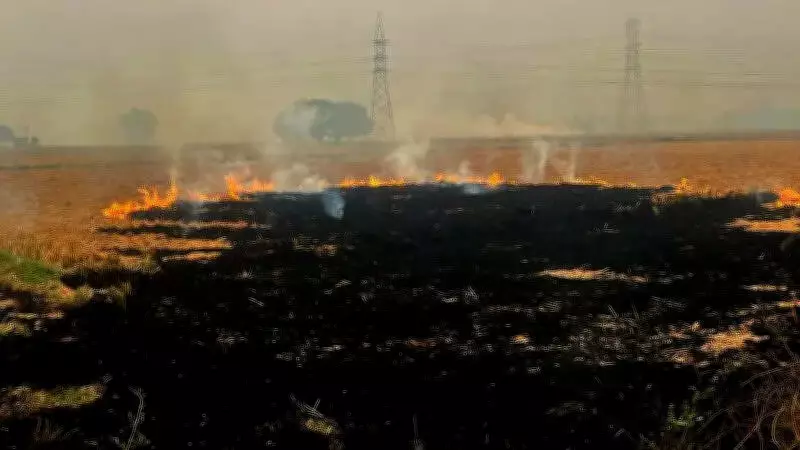
Stubble Burning Crisis: Madhya Pradesh Dominates with Over 72% of Cases This Season
Even as two more crop residue burning cases were reported from Punjab on Friday, taking the state's count to a mere eight, faraway Madhya Pradesh continued to lead significantly in residue burning activity, according to the latest monitoring data. This stark contrast underscores a persistent environmental challenge across India's agricultural heartlands.
Friday's Alarming Figures Highlight MP's Dominance
On Friday alone, Madhya Pradesh reported a staggering 1,091 out of 1,423 total stubble burning cases recorded across various states. This surge pushed its seasonal tally past 22,000 to an alarming 22,850 incidents. Of the total season count, 16,495 burning incidents originated from Madhya Pradesh alone, accounting for over 72% of all cases documented during the current wheat harvesting season.
Long-Term Trends: MP Contributes Nearly 50% of Cases Over Five Years
As per the Consortium for Research on Agroecosystem Monitoring and Modeling From Space (CREAMS), which monitors stubble burning biannually after paddy and wheat harvests, Madhya Pradesh has contributed nearly 50% of cases over the last five years. Out of 221,389 total instances reported from 2022 to April 17, 2026, 111,181 were from MP, followed by 52,311 from Uttar Pradesh, 47,985 from Punjab, 9,793 from Haryana, and 119 from Delhi.

Regional Hotspots and District-Level Data
A maximum of 2,600 burning cases were recorded in the Siddharthnagar district of Uttar Pradesh, highlighting localized intensity. Furthermore, 34 districts across Madhya Pradesh and Uttar Pradesh reported over 100 cases each by April 17, indicating widespread practice rather than isolated incidents.
Historical Context: MP Topped During Paddy Harvesting Too
Earlier, during the paddy harvesting of the 2025 kharif season, Madhya Pradesh similarly topped the list, followed by Uttar Pradesh and Punjab. By November 30, 2025, MP had recorded 17,067 cases, compared to 7,290 in Uttar Pradesh and 5,114 in Punjab. This consistent pattern over multiple seasons suggests deep-rooted agricultural practices that are resistant to change.
The data reveals a critical need for targeted interventions in Madhya Pradesh and other high-incidence states to curb stubble burning and mitigate its environmental impacts.






