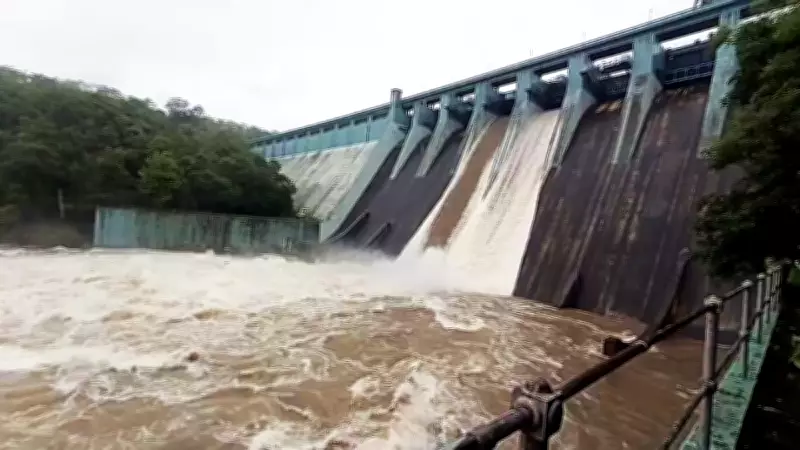
How Mumbai's Water Supply Depends on Monsoon and Seven Reservoirs
Mumbai's water supply throughout the year is determined by the performance of the monsoon season and the collective storage in the city's seven reservoirs. As of July 2026, the reservoirs hold 85% of their total capacity, which is sufficient to meet demand until the next monsoon, according to the Brihanmumbai Municipal Corporation (BMC).
The Seven Reservoirs and Their Roles
The seven reservoirs—Upper Vaitarna, Modak Sagar, Tansa, Middle Vaitarna, Bhatsa, Vihar, and Tulsi—are located in the catchment areas around Mumbai. These reservoirs collect rainwater during the monsoon months from June to September. The total storage capacity of these reservoirs is approximately 14.47 lakh million litres. When full, they can supply water to Mumbai for about one year.
Bhatsa is the largest reservoir, contributing nearly 40% of the city's total water supply. Upper Vaitarna and Middle Vaitarna together provide about 25%, while Tansa and Modak Sagar contribute around 20%. Vihar and Tulsi are smaller and primarily serve as backup sources.

Monsoon Patterns and Water Management
The monsoon in Mumbai typically begins in June and peaks in July and August. The amount of rainfall directly impacts the water levels in the reservoirs. In years of deficient rainfall, the BMC imposes water cuts to conserve supply. For instance, in 2024, due to below-average monsoon, the BMC reduced water supply by 10% from July to September.
According to a BMC official, "The monsoon is the lifeline for Mumbai's water supply. We monitor the daily water levels and forecast demand to ensure equitable distribution throughout the year." The BMC uses a formula based on reservoir levels to decide on water cuts. If storage falls below 50% by September, cuts are implemented.
Water Supply Infrastructure
From the reservoirs, water is treated at filtration plants and then distributed through a network of pipelines to households. The BMC supplies about 3,850 million litres per day (MLD) to the city. However, demand is higher, estimated at 4,200 MLD, leading to a deficit that is managed through rationing and water conservation measures.
The BMC has also implemented projects to reduce leakage and improve efficiency. In 2025, the corporation reported a 5% reduction in water loss due to pipeline repairs and metering.
Impact of Climate Change
Climate change poses challenges to Mumbai's water security. Extreme weather events, such as intense rainfall or prolonged dry spells, can disrupt the monsoon pattern. The BMC is working on increasing storage capacity by desilting reservoirs and exploring alternative sources like desalination plants. However, these measures are long-term and expensive.
In conclusion, the interplay between the monsoon and the seven reservoirs is critical for Mumbai's water supply. With current storage at a healthy 85%, the city is well-placed for the coming year. But sustained management and adaptation to climate variability remain essential.