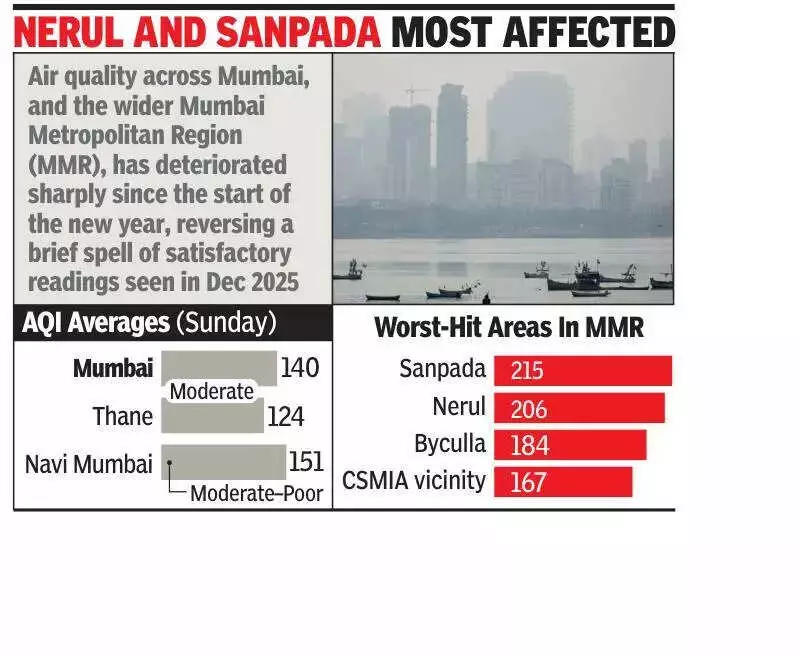
The new year has ushered in a thick blanket of deteriorating air for Mumbai and its surrounding regions. Over the past four days, the air quality across the Mumbai Metropolitan Region (MMR) has taken a sharp turn for the worse, slipping from 'satisfactory' to 'moderate' and even into the 'poor' category in several concerning pockets.
A Steady Decline in Air Quality Metrics
The data reveals a clear and worrying trend. On Sunday, Mumbai recorded an average Air Quality Index (AQI) of 140, a significant jump from 106 on Saturday. This is markedly higher than the 79 and 90 recorded on Friday and Thursday, respectively. The decline was not limited to the island city.
Thane city witnessed a steady worsening, with its average AQI rising to 124 from 82 on January 1. Navi Mumbai experienced the most dramatic fall, deteriorating sharply from AQIs of 99 and 86 on January 1 and 2 to an alarming average of 151 by Sunday.

Local Hotspots Record Dangerous Levels
Several localities reported pollution levels far above the city's average, painting a grim picture of hyper-localised air quality crises. In Mumbai, Byculla recorded the highest AQI at 184, followed by the area around the Chhatrapati Shivaji Maharaj International Airport at 167.
The situation was more severe in Navi Mumbai, where air quality officially slipped into the 'poor' category. Nerul recorded an AQI of 206, and Sanpada emerged as the most polluted locality with an AQI of 215. The AQI measures the concentration of toxic particulate matter, PM2.5 or PM10, in the air.
Causes and Health Implications
Environmental experts have attributed this sharp decline to a combination of unfavourable winter conditions and persistent dust pollution. Bhagwan Kesbhat, CEO of the environmental organisation Waatavaran, explained that falling temperatures during winter cause pollutants to get trapped closer to the ground.
"Without clear skies and adequate wind movement, dispersion becomes difficult and pollution levels rise sharply," Kesbhat said. He critically noted that while the Maharashtra Pollution Control Board (MPCB) and Brihanmumbai Municipal Corporation (BMC) claim to have taken steps to curb dust from construction sites—a source contributing nearly 30% of the city's pollution load—data over several years shows its share has largely remained unchanged.
The health implications are direct and serious. Prolonged exposure to 'moderate' category air can cause minor respiratory discomfort, especially for sensitive groups like children, the elderly, and those with pre-existing conditions. Breathing 'poor' quality air, as seen in Nerul and Sanpada, can cause breathing discomfort to most people on prolonged exposure.
This recurring annual crisis underscores the urgent need for more effective and enforceable measures to tackle the root causes of pollution, particularly construction and road dust, to safeguard the health of millions of Mumbaikars.