

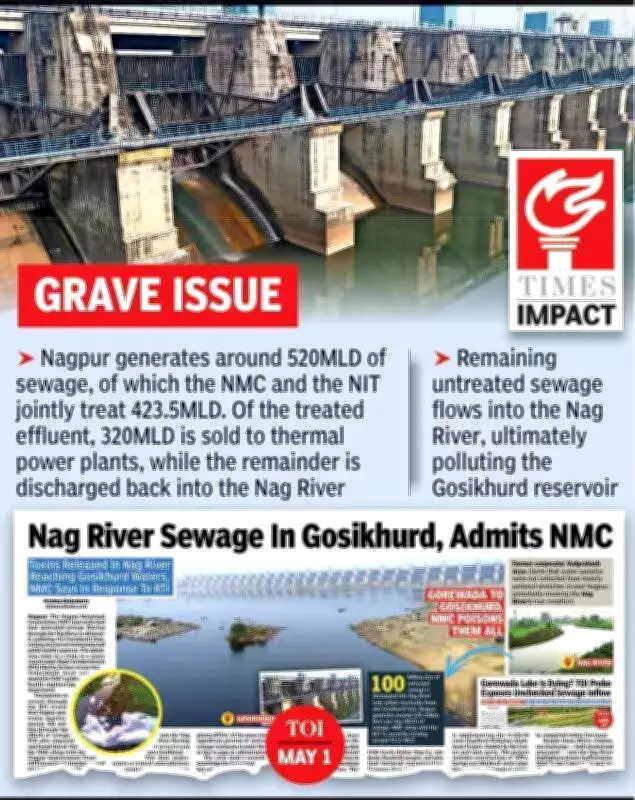
The Nagpur Bench of the Bombay High Court on Thursday took suo motu cognisance of a Times of India report highlighting pollution in the Nag River. The court converted the report into a Public Interest Litigation (PIL), expressing serious concerns over the discharge of partly untreated sewage into the river, which is adversely affecting the water quality of the Gosikhurd dam.
Court Proceedings and Directions
A division bench comprising Justices Anil Kilor and Raj Wakode observed that the issue is a grave matter concerning the environment and public health. The bench directed the Nagpur Municipal Corporation (NMC) Commissioner to submit relevant information and documents on record. Advocate Rushda Khan was appointed as amicus curiae, while Advocate Mayuri Deshmukh represented the state. The next hearing has been scheduled for June 25.
TOI Report Findings
The TOI report, published on May 1, cited data from an RTI reply obtained by former corporator Vedprakash Arya from the NMC's public health engineering department. The reply confirmed that untreated sewage entering the Nag River ultimately pollutes the Gosikhurd reservoir.

Nagpur generates approximately 520 million litres per day (MLD) of sewage. Of this, the NMC and the Nagpur Improvement Trust (NIT) jointly treat 423.5 MLD. Out of the treated effluent, 320 MLD is sold to the Koradi and Khaparkheda thermal power stations, while the remainder is discharged back into the Nag River—the same river system that the civic body is spending crores to clean.
Concerns Over Infrastructure and Health Impact
The bench noted that despite the state running a massive cleanup of the river, untreated sewage water continues to be released into it. The court also highlighted the TOI report's findings that gaps in sewerage infrastructure are causing untreated sewage to flow into the river. Additionally, the bench pointed out that the NMC's health department had not conducted any survey on the health impact of contaminated Gosikhurd water on citizens. Water samples were not being collected from heavily polluted stretches in east Nagpur, with test reports from September 2025 drawn from relatively cleaner locations such as Shankar Nagar showing low Biochemical Oxygen Demand (BOD) and Chemical Oxygen Demand (COD) levels.
Nag River Pollution Abatement Project
The Rs1,927 crore Nag River Pollution Abatement Project, funded by the central and state governments, is currently underway. It includes the construction of new sewage treatment plants, over 500 km of sewerage lines, and new pumping stations across the city.






