Nagpur's Unplanned Growth Emerges as Key Driver of Air Pollution Crisis
Rapid and largely unplanned residential expansion has emerged as one of the primary factors contributing to the escalating air pollution levels in Nagpur, according to Neeri scientist Asha Lalwani. The expert made this critical observation during her address at a seminar focused on Air Quality Index and air pollution, which was organized by the Vidarbha Economic Development Council on Saturday.
Concrete Expansion and Its Environmental Consequences
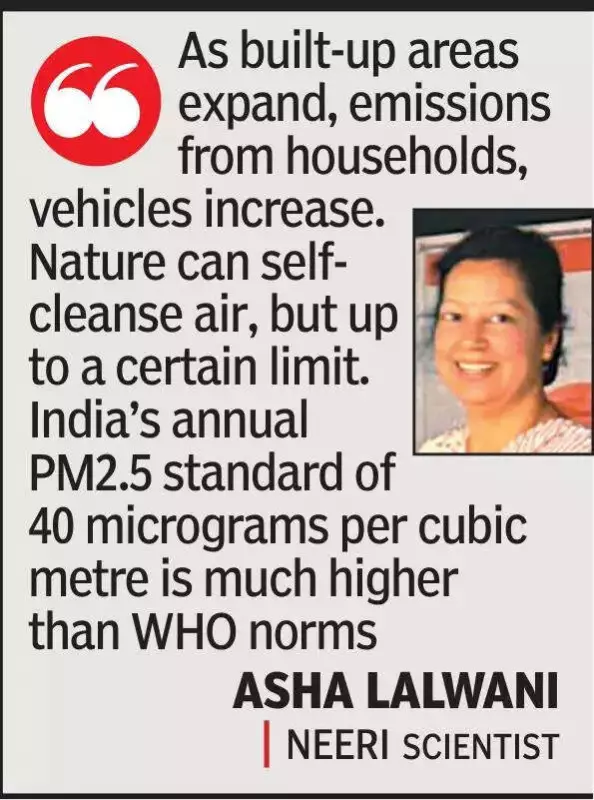
Presenting a comprehensive data-driven overview, Lalwani highlighted that Nagpur has experienced a dramatic surge in both population and residential structures between 1990 and 2020. This growth has resulted in most parts of the city being covered by concrete, significantly altering the urban landscape. "As built-up areas continue to expand, emissions from households, vehicles, and associated activities increase substantially," she explained. Lalwani further emphasized that while nature possesses some capacity for self-cleansing of air, this ability is limited and easily overwhelmed by excessive pollution.
Understanding Air Pollution Components and Regulatory Framework
Lalwani, who works as a statistician specializing in air pollution and air resources, provided detailed insights into the composition of air pollution. She clarified that it broadly consists of gaseous pollutants and particulates, each posing distinct challenges. The scientist traced India's regulatory journey in combating air pollution, citing significant milestones including:

- The Motor Vehicles Act rules of 1987
- Bharat Emission Standards introduced in 2000
- Bharat Stage VI norms implemented in 2020
- The National Clean Air Programme which aims for a 40% reduction in particulate matter
She noted that India's annual PM2.5 standard of 40 micrograms per cubic meter remains substantially higher than World Health Organization recommendations. Additionally, Lalwani pointed out that geogenic dust further elevates pollution levels in many regions, complicating mitigation efforts.
Comparative Analysis and Ongoing Initiatives
When comparing pollution levels across different cities, Lalwani revealed that Delhi's pollution is nearly four times higher than Nagpur's. However, she cautioned against complacency, stating that "comparatively lower pollution does not necessarily mean clean air." The scientist highlighted several important initiatives currently underway, including the Swachh Vayu Sarvekshan and various action plans developed by the Central Pollution Control Board.
Severe Health Implications of Poor Air Quality
Pulmonologist Dr. Abhishek Faye outlined the severe health impacts resulting from poor air quality during the seminar. He identified PM2.5 as the "biggest threat" to public health, explaining that these fine particles penetrate deep into the lungs and respiratory system. This exposure significantly raises risks for numerous health conditions including:
- Asthma and respiratory disorders
- Chronic Obstructive Pulmonary Disease
- Stroke and cardiovascular events
- Cardiac arrest
- Lung cancer
Dr. Faye particularly emphasized that people below 40 years of age face heightened vulnerability to these health consequences, making early intervention crucial.
Calls for Stricter Standards and Compliance
Architect and environmentalist Avantika Chitnavis emphasized the urgent need for stricter Air Quality Index standards during her presentation. She advocated for updating the National Clean Air Programme beyond its 2018 framework to address evolving challenges. Chitnavis also raised significant concerns regarding thermal power plants, specifically noting that the Koradi plant has repeatedly failed to comply with established environmental norms, contributing to the region's pollution burden.
The seminar collectively underscored the complex relationship between urban development patterns and environmental health, with experts calling for more integrated approaches to urban planning and pollution control in Nagpur and similar rapidly expanding cities across India.