Nagpur's Urban Tiger Crisis: Over 20 Big Cats Roam City Periphery
The recent death of a sub-adult male tiger on railway tracks near Jamtha has exposed a deeply concerning trend in Nagpur: tigers are increasingly venturing close to urban areas, heightening fears of potential man-animal conflicts. This incident has brought into sharp focus the precarious situation where big cats and human populations are coming into dangerously close proximity.
Alarming Numbers in Semi-Urban Territories
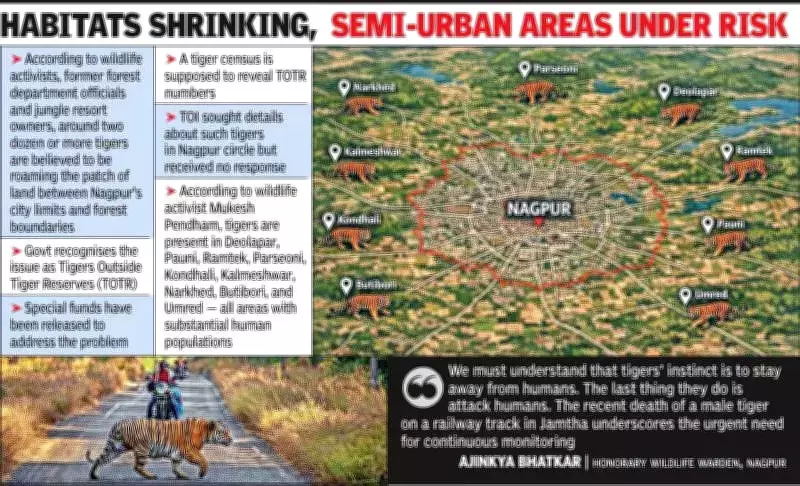
According to stakeholders working across various forest-related fields, an estimated two dozen or more tigers are believed to be roaming the patch of land between Nagpur's city limits and the forest boundaries. Wildlife activists, former forest department officials, and jungle resort owners all concur that a significant number of tigers now inhabit territorial areas—lands located outside designated forest reserves.
While an official survey has yet to provide exact numbers, stakeholders estimate that a minimum of approximately 20 tigers are currently roaming the periphery of Nagpur city. The absence of comprehensive data makes precise quantification challenging, but the consensus points to a substantial and growing presence.

Expert Warnings and Government Recognition
Mukesh Pendham, a wildlife activist and zoologist, issued a stark warning: "Don't be surprised if the census later reveals that more than 50 tigers are roaming in the semi-urban areas. Tigers are entering human habitats and attacking people. It's no longer a question of humans venturing into forests."
He cited a chilling incident from last month in Maudi village, where a man tending to his buffalo was attacked by a tiger and dragged away. Pendham emphasized that the tiger population is increasing, and these majestic predators are steadily encroaching upon human settlements.
The government has formally acknowledged this escalating issue through the Tigers Outside Tiger Reserves (TOTR) classification. Special funds have been released to address the problem, and the upcoming tiger census is expected to reveal specific TOTR numbers. However, when TOI sought details about such tigers in the Nagpur circle from the forest department, no response was received by the time of publication.
Geographic Spread and Urgent Concerns
Pendham identified multiple areas where Nagpur tigers are present, all regions with substantial human populations that fall outside any protected area:
- Deolapar
- Pauni
- Ramtek
- Parseoni
- Kondhali
- Kalmeshwar
- Narkhed
- Butibori
- Umred
Describing the situation as a "ticking time bomb," Pendham expressed frustration that the government appears to have no concrete plans to address this looming crisis effectively.
Census Expectations and Conservation Perspectives
All eyes are now on the All-India Tigers Estimation (AITE) 2026, which will specifically record tigers living outside forests. Ajinkya Bhatkar, honorary wildlife warden of Nagpur, cautioned against premature speculation: "Camera traps are being put up for the census, and I would not like to comment on estimates till official figures come."
Bhatkar provided important context about tiger behavior: "We must understand that tigers' instinct is to stay away from humans. The last thing they do is attack humans. That's why human deaths due to tiger attacks must be looked into with a wider perspective."
Call for Comprehensive Monitoring and Resources
Bhatkar emphasized that regular assessments of tiger populations, movement patterns, prey base, and habitat conditions are essential for mitigating human-wildlife conflict. The recent death of the male tiger on the railway track in Jamtha underscores the urgent need for continuous monitoring.
He praised the dedication of territorial staff who are working diligently despite limited resources but stressed that they must be strengthened with adequate funding and manpower. "They must be strengthened with adequate funding and manpower to monitor and conserve wildlife beyond protected areas effectively," Bhatkar asserted.

This developing situation in Nagpur represents a critical challenge at the intersection of wildlife conservation and urban safety, demanding immediate attention and strategic intervention from both conservation authorities and government agencies.