NASA's Orbital Image Reveals Argentina's Pink Heart-Shaped Salt Lake
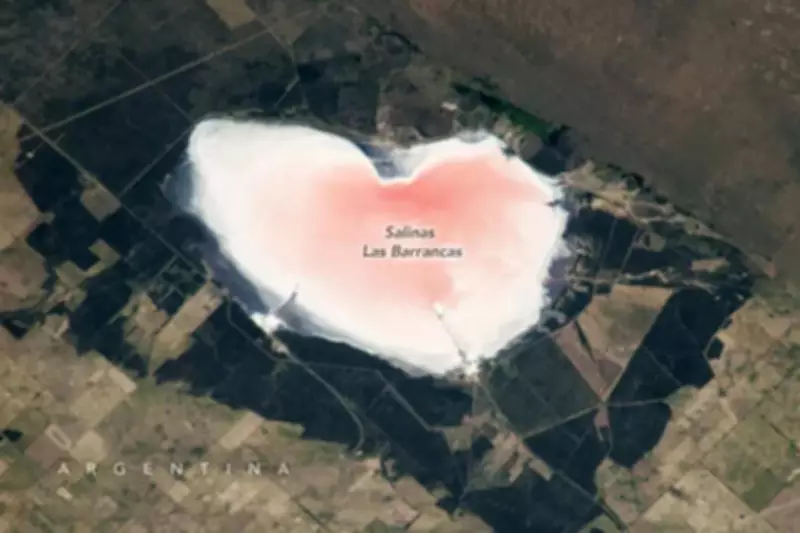
During the peak of the austral summer, a shallow salt lake in southern Argentina undergoes a remarkable transformation, turning a distinctive muted shade of pink. This site, known as Salinas Las Barrancas, is located near the port city of Bahía Blanca. In January 2024, an astronaut aboard the International Space Station captured a strikingly clear image of this lake from orbit. The photograph, subsequently released by the United States space agency NASA, depicts a heart-shaped basin filled with pastel-colored water, bordered by pale salt flats. This image gained widespread circulation after NASA published it through its Earth Observatory platform, attracting attention not only for its aesthetic appeal but also for the underlying environmental and industrial activities occurring in the region.
Geological Formation and Seasonal Changes
Salinas Las Barrancas, also locally referred to as Laguna de Salinas Chicas, lies within a natural depression situated below sea level. When seasonal rains arrive, water accumulates across the flat basin. During the drier months, a significant portion of this water evaporates, leaving behind thick layers of salt. From the vantage point of space, as seen in the NASA image, the lake's outline appears almost symmetrical. However, from ground level, it presents a more subdued appearance—a vast expanse of brine and crusted white minerals stretching across the landscape.
Traditional Salt Mining Practices
Salt has been harvested at this location for decades, with local workers extracting up to 300,000 metric tons twice annually, typically between the region's rainy seasons. Remarkably, most of the mineral content is naturally replenished by subsequent rainfall. The mining process remains largely manual, involving workers who scrape salt from the surface using handheld tools. Protective clothing is essential due to the intense glare from white crystals under the strong sunlight, which can pose risks to eyes and skin. Despite the substantial scale of extraction, experts estimate that the salt reserves could potentially last for thousands of years under current operational patterns.

The Science Behind the Pink Hue
The lake's unique pink coloration is attributed to microscopic life forms thriving in highly saline conditions. In such extreme environments, few organisms can survive, with one notable exception being Dunaliella algae. This algae produces red and yellow pigments known as carotenoids, which enable it to tolerate extreme salt concentrations and intense sunlight. Tiny crustaceans feed on these algae, and in turn, birds consume the crustaceans. This process allows the pigments to move up the food chain, influencing the coloration of the wildlife that frequents the salt flats.
Wildlife Dependent on Carotenoids
Among the most visible species in this ecosystem are the Chilean flamingo and the endangered yellow cardinal. Flamingos are born with greyish-white feathers, which develop their characteristic pink hue through a diet rich in carotenoids. Similarly, yellow cardinals, which naturally have red tones, rely on these pigments for their bright and vibrant appearance. The vegetation around the lake's edge is sparse but salt-tolerant, surviving in conditions where freshwater plants cannot. Although the setting appears harsh, it supports a small yet resilient ecosystem adapted to these unique environmental factors.
A Landscape of Contrasts
From orbit, the lake appears decorative and almost artificial, but on the ground, it is a functional landscape shaped by climate, salt, and industry. The color of the lake shifts with seasonal changes and lighting conditions, while mining activities continue quietly. Birds return to the area when conditions permit, highlighting the dynamic interplay between natural processes and human activity in this remote Argentine location.