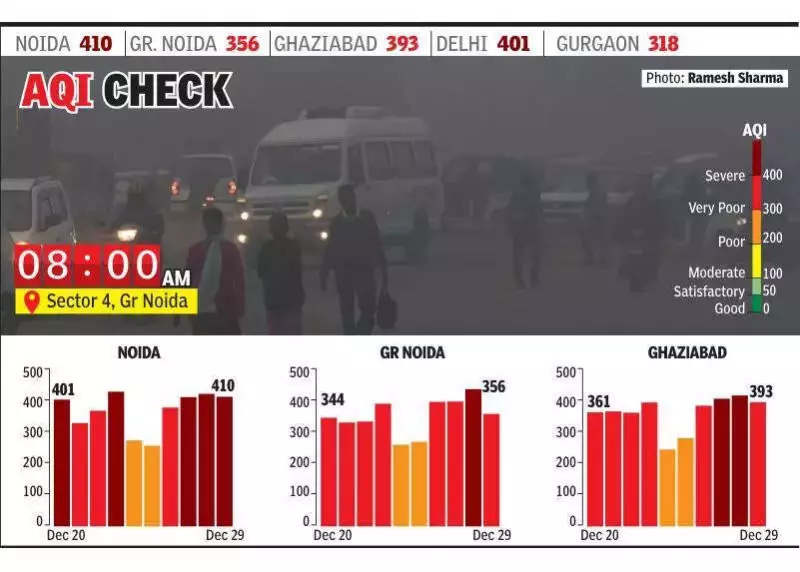
The air quality in the National Capital Region (NCR) showed a marginal improvement on Monday but continued to pose a severe health risk, particularly in Noida. While the blanket of dense fog began to lift slightly after 9 am, it left behind a grim picture of hazardous pollution levels that are expected to persist for the coming days.
Severe Air Grips Key NCR Cities
On Monday, Noida recorded an Air Quality Index (AQI) of 410, which falls in the 'severe' category. This was a minor relief from Sunday's reading of 419, but still far from safe. Greater Noida saw a more significant shift, moving from the 'severe' zone on Sunday (AQI 434) to the 'very poor' category with an AQI of 365. Ghaziabad also noted an improvement, with its AQI dropping to 393 from 414 a day earlier.
However, the national capital, Delhi, witnessed a deterioration. The city's air quality slipped back into the 'severe' category with an AQI of 401, compared to 390 ('very poor') recorded on Sunday. Monitoring stations in areas like Wazirpur (AQI 462), Jahangirpuri (460), Rohini (456), and Anand Vihar (455) were among the most polluted by 6 pm.

Localised Pollution Hotspots Within Cities
A closer look at the data reveals stark differences even within the same city. In Noida, Sector 1 was the worst affected with an AQI of 451, followed by Sector 116 (411) and Sector 125 (405), all in the 'severe' range. Sector 62 fared relatively better at 371 ('very poor').
Similarly, in Ghaziabad, Loni (AQI 442) and Vasundhara (412) suffered 'severe' air, while Sanjay Nagar (364) and Indirapuram (353) recorded 'very poor' levels. In Greater Noida, Knowledge Park V (387) and Knowledge Park III (324) both reported 'very poor' air quality.
Dense Fog and Calm Winds Worsen Conditions
The region was enveloped in a thick layer of fog on Monday morning, reducing visibility to as low as 50 meters until 8:30 am. Conditions improved slightly thereafter, with visibility extending to about 100 meters from 9 am onwards. The India Meteorological Department (IMD) has forecast that these dense fog conditions are likely to continue in the region until at least December 31st.
Meteorological factors played a key role in trapping pollutants. According to the Indian Institute of Tropical Meteorology (IITM), surface winds on Monday primarily came from the north-west direction. Their speed was less than 16 kmph during the afternoon and dropped further to below 10 kmph in the evening and night, preventing the dispersal of harmful particles.
The forecast for Tuesday is not encouraging. Predominant winds are expected from the west-north-west direction, with speeds staying below 15 kmph in the morning and afternoon before falling again to less than 10 kmph in the evening. With fog set to continue, the IITM Pune has stated that the AQI is likely to hover in the 'very poor' to 'severe' zones for the next few days. The air quality on January 1st is predicted to be severe, with very poor conditions expected to persist thereafter.