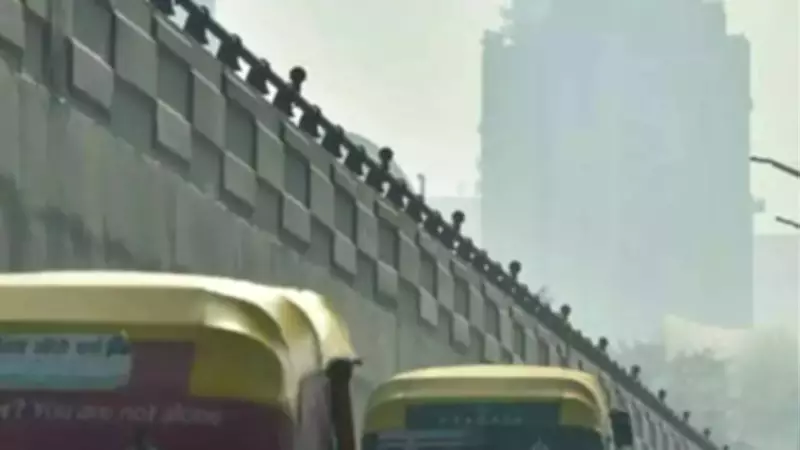
NCR Cities Dominate India's Pollution Rankings in January with Severe Air Quality
A recent monthly analysis by the Centre for Research on Energy and Clean Air (CREA) has highlighted a grim reality for residents in the National Capital Region (NCR). Four cities—Ghaziabad, Delhi, Noida, and Gurgaon—topped India's pollution charts throughout January, with fine particulate matter (PM2.5) consistently lingering in the 'very poor' to 'severe' categories. This persistent smog left inhabitants breathing air nearly ten times dirtier than the safer limits recommended by the World Health Organisation (WHO).
Alarming Pollution Levels Across Key Urban Centers
Ghaziabad emerged as the most polluted city in the country, recording a monthly PM2.5 average of 184 µg/m³. Delhi followed closely with 169 µg/m³, while Gurgaon ranked fourth nationally with a mean concentration of 163 µg/m³. In Gurgaon, air quality remained 'very poor' to 'severe' on 25 out of 31 days, featuring three 'severe' days and 22 'very poor' days. Only two 'moderate' days were recorded, with no 'satisfactory' or 'good' air days throughout the month.
These figures starkly exceed established standards: Gurgaon's PM2.5 levels were nearly three times India's daily National Ambient Air Quality Standard of 60 µg/m³ and approximately ten times the WHO guideline of 15 µg/m³. The persistence of high pollution was evident, with Ghaziabad appearing in the daily top 10 most polluted cities list on 28 days, Delhi on 27 days, Gurgaon on 25 days, and Noida on 24 days.

Widespread Air Quality Issues in Haryana and Beyond
Within Haryana, Gurgaon was the most polluted monitored location, but other districts also reported concerning levels. Dharuhera recorded 150 µg/m³, Narnaul 126 µg/m³, Charkhi Dadri 121 µg/m³, and Manesar 112 µg/m³. Additional areas with high monthly averages included Faridabad (98 µg/m³), Panipat (93 µg/m³), and Bhiwani (88 µg/m³). Overall, 19 of Haryana's 25 monitored locations surpassed the national limit in January, indicating a regional air quality crisis.
Across India, CREA noted that 53 cities featured on the daily top 10 most polluted list at least once during the month, demonstrating that winter pollution is not confined to the NCR. Among major metros, Delhi and Kolkata exceeded national limits, while Chennai, Mumbai, and Bengaluru stayed below the standard. Damoh in Madhya Pradesh was identified as the cleanest city in January, with a monthly PM2.5 average of 17 µg/m³.
Calls for Strengthened Air Quality Strategies
Manoj Kumar, India Analyst at CREA, emphasized the need for robust policy measures. He stated that the upcoming revision of the National Clean Air Programme (NCAP) presents a critical opportunity to tighten India's air quality strategy. "This revision must focus on prioritising PM2.5 and its precursor gases (SO2 and NO2) over PM10, revising the list of non-attainment cities, setting stricter emission standards for industries and power plants, and adopting an airshed-based approach to address air pollution at a regional scale," Kumar added.
The report underscores the urgent need for comprehensive actions to mitigate air pollution, particularly in urban hotspots, to safeguard public health and environmental sustainability.