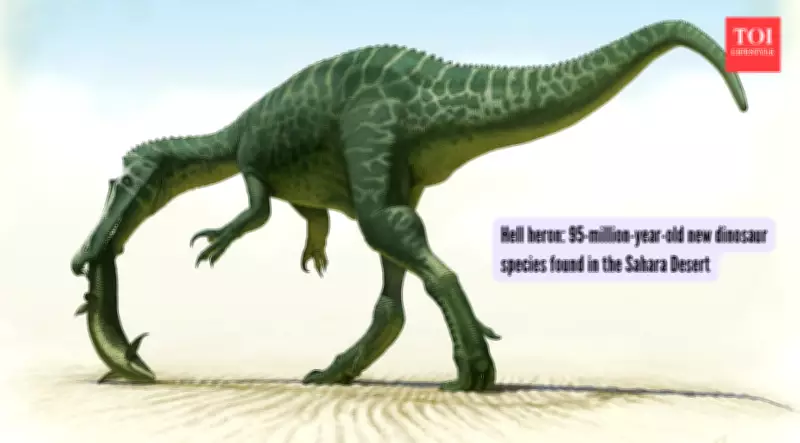
New 'Hell Heron' Dinosaur Species Discovered in Sahara Desert Rewrites History
Deep within the scorching expanse of the Sahara Desert, where endless dunes conceal ancient secrets, a team of paleontologists has unearthed a fossil treasure that is fundamentally rewriting our understanding of dinosaur evolution. This remarkable find offers a vivid window into a lost world, dating back 95 million years, when rivers and lush forests dominated what is now arid desert.
The Astonishing Spinosaurus Mirabilis
The newly identified species, named Spinosaurus mirabilis or "astonishing Spinosaurus," was discovered at a remote site called Jenguebi in Niger. Fossils first emerged in 2019, but extensive excavations in 2022 revealed more complete specimens, including a striking scimitar-shaped crest on its skull. These findings have been detailed in a groundbreaking paper published in the prestigious journal Science.
Lead researcher Paul Sereno from the University of Chicago described the moment of discovery as unforgettable. When his team assembled a 3D skull model on a laptop screen in their desert camp, they gathered in awe. "That’s when it truly hit us," Sereno stated, as covered by Reuters, highlighting the profound impact of this paleontological breakthrough.

A Freshwater Predator in a Lush Ancient Landscape
This colossal dinosaur, roughly the length of a school bus and weighing several tons, thrived 95 million years ago in an environment that was far different from today's desert. The region was then a verdant landscape crisscrossed by rivers and dense forests. The unique crest of S. mirabilis, likely colorful and sheathed in keratin, represents a pinnacle in spinosaur evolution, according to researchers.
Unlike its coastal relatives, this species was a specialized hunter in inland freshwater systems, far from ancient seas. Its long snout and conical, interlocking teeth formed what scientists describe as a "natural trap" for slippery fish, functioning similarly to modern crocodiles. University of Chicago reports emphasize this adaptation for aquatic predation.
The 'Hell Heron' Hunting Strategy
Sereno vividly envisions S. mirabilis as a "hell heron," a dinosaur that waded into waters up to two meters deep on sturdy legs but primarily stalked shallower areas. "I envision this dinosaur as a kind of ‘hell heron’ that had no problem wading on its sturdy legs into two metres of water but probably spent most of its time stalking shallower traps," he explained. This behavior suggests a versatile predator adept at navigating riverine environments.
The discovery site, located within the fossil-rich Farak Formation sandstones, has yielded multiple specimens of S. mirabilis along with other dinosaur remains, enriching our knowledge of this ancient ecosystem.
Reshaping Scientific Debates on Spinosaurids
Spinosaurids have long been a topic of intense debate among paleontologists, with disagreements over whether they were true swimmers or merely riverbank stalkers. This new discovery adds a critical layer to this mystery. Steve Brusatte of the University of Edinburgh, who was not involved in the research, noted, "This discovery adds another layer to the mystery," underscoring its significance.
Sereno went further, calling it "the coup de grâce for the aquatic hypothesis," as it shifts scientific perspectives toward inland freshwater habitats for these dinosaurs. Each fossil find, as reported by Phys.org, edges us closer to reconstructing their enigmatic world, challenging previous assumptions and opening new avenues for research.
This groundbreaking find not only unveils a new species but also transforms our understanding of dinosaur ecology and evolution, highlighting the Sahara Desert as a crucial archive of prehistoric life.