

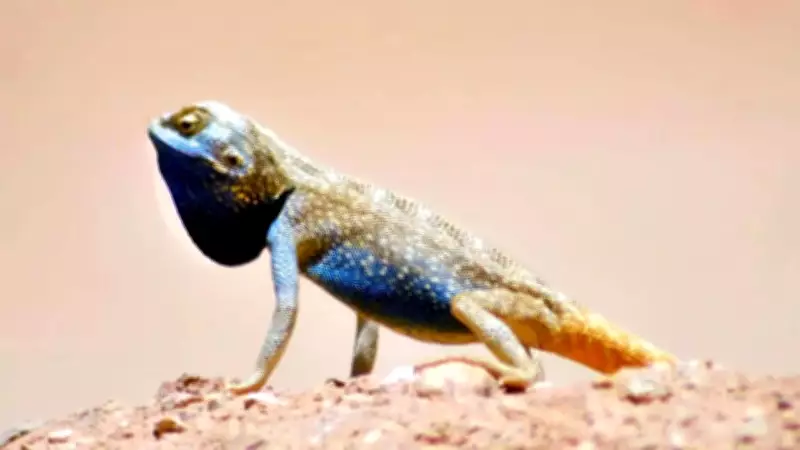
New Pale Agama Lizard Species Documented in Saudi Arabia's Northern Borders
The Saudi Press Agency (SPA) has reported the discovery of a new species of Pale Agama lizard, scientifically named Trapelus agnetae, in the Northern Borders area of Saudi Arabia. This finding underscores the health and stability of the country's desert ecosystems, aligning with broader environmental conservation efforts.
Unique Adaptations of the Pale Agama
This medium-sized lizard, belonging to the Agamidae family, is uniquely adapted to the harsh volcanic and rocky terrains of northern Saudi Arabia. Key identifying features include:
- A triangular-shaped head and a flattened body with long legs equipped with claws.
- One or two rows of small spines on its head above the ear canal, distinguishing it from other species.
- A total length of approximately 19 cm, with a body (snout-to-vent) measuring about 8.8 centimetres.
The Pale Agama plays a crucial role in the local food chain, preying on insects and serving as a food source for predatory birds such as owls.

Habitat and Survival Strategies
The Northern Borders region is identified as a primary habitat for this species, which thrives in:
- Volcanic desert areas.
- Open rocky plains.
- Dry grasslands.
Its survival in arid environments is aided by a light grey coloration with dark grey and white dorsal striping, providing camouflage against volcanic rock and gravel. As a diurnal reptile, it is most active during warm daytime temperatures for feeding and other activities.
Ecological Significance and Food Chain Role
The SPA report emphasizes the Pale Agama's dual role in maintaining biological balance:
- It acts as a predator, regulating insect populations in the desert.
- It serves as prey for higher-order predators like birds of prey and owls, supporting ecosystem stability.
This interconnectedness helps sustain the food web and promotes environmental health in the region.
Implications for Saudi Vision 2030
The documentation of the Pale Agama and other rare species serves as a key indicator of environmental health. This sighting supports the Saudi Green Initiative and Vision 2030 goals, which aim to:
- Protect 30% of the Kingdom's land and sea areas.
- Preserve biodiversity through strict environmental regulations.
- Promote ecological flourishing as part of national development strategies.
The discovery reinforces the Northern Borders region's status as a stable and healthy ecosystem, contributing to Saudi Arabia's commitment to environmental sustainability.






