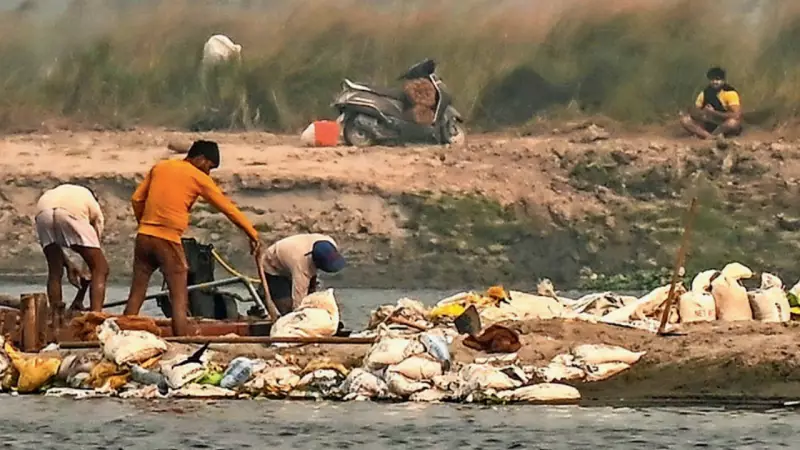
A committee appointed by the National Green Tribunal (NGT) has uncovered extensive illegal sand mining operations in the ecologically sensitive Yamuna floodplains, spanning the border between Delhi and Ghaziabad. The findings confirm a previous media report about an illegal embankment built across the river to facilitate dredging.
Widespread Violations Uncovered in Surprise Checks
The joint inspection committee, comprising members from the Central Pollution Control Board (CPCB), the Ministry of Environment, Forest and Climate Change (MoEFCC), and the Commission for Air Quality Management (CAQM), conducted surprise visits earlier this month. Their report, submitted to the NGT on December 19, paints a grim picture of regulatory failure and environmental damage.
While the mining lease in the Navraspur area of Loni, Ghaziabad, was legally granted, miners brazenly operated far beyond the permitted boundaries. The panel found mining activity had occurred up to 110 metres outside the legal lease area, directly in the centre of the Yamuna's mainstream. To access the river, illegal ramps were constructed using sandbags, a method earlier highlighted in a news report.

Flouting of Environmental Norms and GRAP Rules
The committee's assessment was scathing, detailing a long list of ignored regulations and ecological safeguards:
- Mining continued unabated even during the enforcement of GRAP Stage-III restrictions, when all such activities are prohibited to curb air pollution.
- Heavy machinery excavated the riverbed to depths of 15-20 feet, severely altering the river's morphology.
- Evidence pointed to night-time operations, further evading scrutiny.
- Critical environmental conditions were violated: no plantation drives were undertaken, mandatory six-monthly compliance reports were not submitted, and solar lighting was absent.
- Diesel generator sets were run beyond permitted capacity, and sewage management was inadequate.
- Boundary pillars meant to demarcate the legal mining zone were either missing or submerged.
The panel also discovered a weighing bridge and a site office located about 200 metres from the legal mining area, indicating the scale of the unauthorized operations.
Official Response and NGT Directives
An official from the Ghaziabad mining department acknowledged the violations. He stated that a short-term permit for 1.8 hectares was granted in May for six months, excluding the monsoon ban period. However, environmental norms were breached, leading to a show-cause notice being issued to the leaseholder. Penal action is pending their reply.
The NGT, taking cognizance of the issue, had consolidated all pending cases on Yamuna sand mining. Its principal bench, chaired by Justice Prakash Shrivastava with expert member A Senthil Vel, had formed the joint committee on November 20. In its order dated December 23, the tribunal directed urgent corrective measures.
The panel recommended that authorities in Delhi and Uttar Pradesh must immediately curb illegal mining. It called for action against mining outside lease areas and advised against granting short-term mining leases of less than two years. Specifically, it ordered the Ghaziabad mining department and the Uttar Pradesh Pollution Control Board (UPPCB) to act against mining conducted during the GRAP-III period and ensure no mining occurs in the Yamuna's mainstream.
The report warns that these lapses pose a significant risk of long-term ecological damage to the Yamuna river and its vital floodplains.