

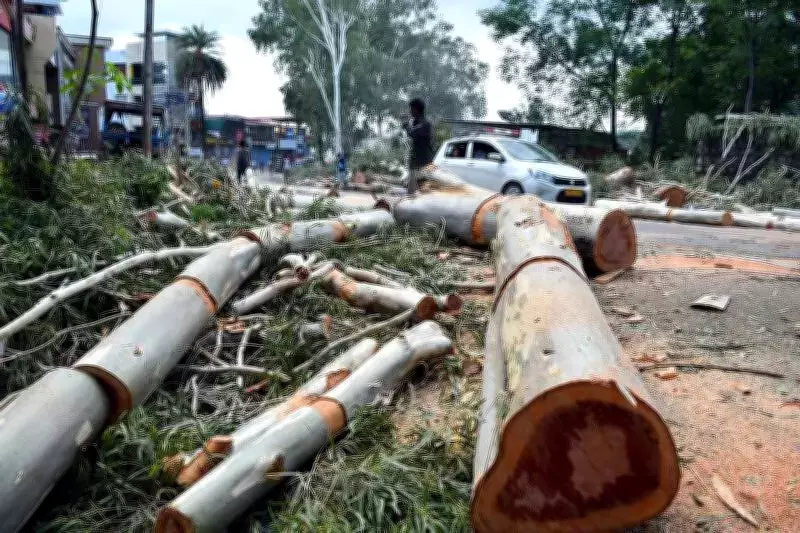
RTI Exposes Massive Tree Felling by NHAI in Uttarakhand for Highway Projects
In a startling revelation, data obtained through a Right to Information (RTI) application has disclosed that the National Highways Authority of India (NHAI) has felled over 83,000 trees across Uttarakhand over the past five years to facilitate various infrastructure developments. The information was procured by a Noida-based RTI activist, shedding light on the environmental impact of highway expansions in the ecologically sensitive state.
Breakdown of Tree Clearance for Major Highway Sections
The RTI response provides a detailed breakdown of the tree clearance figures. A significant portion of the felling occurred on two major national highway stretches. Specifically, 45,681 trees were cut for the Kashipur-Sitarganj section of NH-74, while 15,257 trees were removed for the Rampur-Kathgodam section of NH-87. The data indicates that tree plantation was conducted as compensation, with the department asserting full survival rates for these planted trees. However, plantation statistics for projects such as the Rudrapur or Kashipur bypass were not available due to their ongoing status, leaving gaps in the complete environmental accountability picture.
Environmentalists Raise Concerns Over CAMPA Compliance and Costs
Ashish Garg, a Dehradun-based environmentalist, highlighted regulatory shortcomings, stating, "Regulations under CAMPA (Compensatory Afforestation Fund Management and Planning Authority) are clear that the number of trees planted should be 10 times the number of trees felled. If 84,000 trees are cleared, more than 8 lakh trees should be planted." This points to a potential shortfall in meeting mandatory afforestation requirements. Notably, the RTI data excluded several other projects, including the Bhaniyawala-Rishikesh road widening, suggesting the total tree loss might be even higher.

Financial aspects of the compensatory measures were also scrutinized. The RTI reveals that NHAI deposited Rs 11.2 crore for compensatory afforestation related to these projects. Amit Gupta, the RTI activist, provided further insight into transplantation efforts, noting, "As per available records, tree cutting is being carried out by the forest department in respective regions. However, only 155 trees were transplanted in 2022 and seven in 2025. Of these 162, 139 survived, but a staggering Rs 82.7 lakh was deposited with the concerned forest department for the same. That is a huge cost for transplantation." This raises questions about the cost-effectiveness and scale of transplantation versus felling.
Broader Implications for Uttarakhand's Ecology and Development
These revelations emerge amid growing concerns from eco-activists about excessive tree felling in Uttarakhand, which is adversely impacting local ecology. Garg criticized the development approach, adding, "For the government, the go-to method of development is chopping trees. After massive public agitations, government sometimes revised its initial proposals of chopping down 6,000 trees to 1,000 trees. There is always a better alternative available, provided we look for it." He also addressed challenges in compensatory afforestation, stating, "Then there are excuses of land unavailability for compensatory afforestation. If we chop less trees, we need less land to plant more. The regulations of compulsory plantation are also not being met. How can we retain our natural heritage with such a callous attitude?"
The RTI data underscores a critical tension between infrastructure development and environmental conservation in Uttarakhand. With tree felling figures reaching tens of thousands and compliance with compensatory afforestation regulations under scrutiny, there is an urgent need for greater transparency and adherence to ecological safeguards. The high costs associated with limited transplantation efforts further highlight inefficiencies in current practices, calling for a reevaluation of strategies to balance progress with the preservation of Uttarakhand's natural heritage.






