

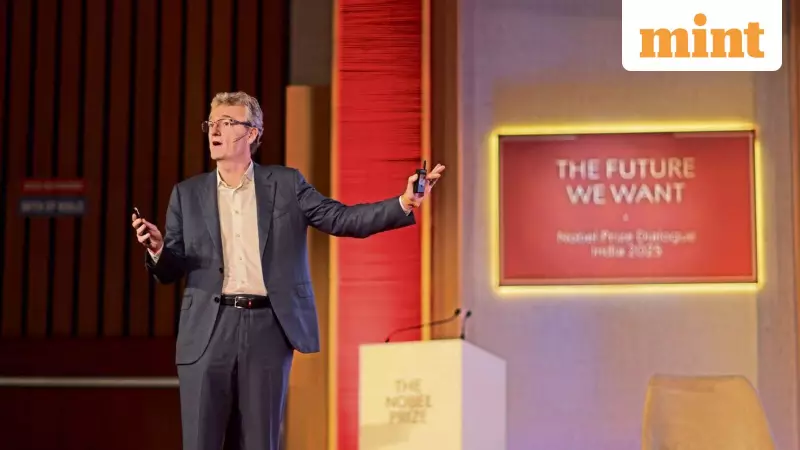
Chemistry Nobel Laureate David MacMillan believes humanity stands on the brink of solving one of its greatest challenges - climate change - through a single breakthrough in catalytic reactions. The 2021 Chemistry Nobel Prize winner shared this optimistic vision during his recent visit to India for the Nobel Prize Dialogue 2025 at the Indian Institute of Science in Bengaluru.
The Power of Organocatalysis
MacMillan, who shared the 2021 Nobel Prize with Benjamin List for developing asymmetric organocatalysis, explained how this revolutionary approach has transformed chemical processes worldwide. Organocatalysis involves designing organic molecules that are non-toxic and easy to handle to speed up chemical reactions, making catalysis cheaper and more environmentally friendly for applications ranging from clothing manufacturing to medication production.
"Organocatalysis has democratized catalysis," MacMillan stated during an exclusive interview. "In India, it's used in almost every lab, every company, every startup." The significance of catalysis extends far beyond laboratories - approximately 90% of industrial-scale chemical reactions utilize catalysis, forming the basis for 35% of global GDP.

Climate Change: The Catalytic Solution
When asked about climate change, MacMillan revealed there are two potential catalytic solutions that could address the crisis. The primary challenge involves designing a catalyst cheap and sustainable enough to react with atmospheric CO2 and reduce it to useful compounds like aldehydes, formyl groups, or methanol.
"The problem is not whether it's possible; it's designing the right catalyst to make it possible," MacMillan explained. "Every chemist knows this, but we do such a bad job at telling people that we've got this possibility." The second approach involves mineralization, though MacMillan noted this process is slower.
Beyond the Laboratory: Chemistry in Society
MacMillan, who describes himself as "a curious person who's deeply interested in the world around him" rather than primarily as a chemist, emphasized the need for better science communication. He pointed out chemistry's public relations problem, where people associate the field with environmental disasters rather than life-saving medicines or beautiful scents.
The Princeton University professor also addressed the challenge of misinformation in science, particularly regarding vaccines. He identified social media echo chambers as particularly problematic, where algorithms return people's existing opinions rather than credible scientific information.
Education emerged as a central theme in MacMillan's philosophy. Having risen from a working-class background in Scotland where his father was a steel worker and mother a maid, he views education as "a great social justice leveller" that must be available to everyone in good quality.
Giving Back and Personal Reflections
MacMillan has put his beliefs into action through charitable work. After winning the Nobel Prize, he established a foundation with his $500,000 prize money, which has since grown through additional donations. The foundation now provides $100,000-200,000 annually to help underprivileged Scottish students access and remain in university.
Reflecting on his role as a father to three daughters, MacMillan noted how this experience has shaped his perspective. "Your sensibilities change when you're the only male in the house," he shared. "You develop empathies in ways you wouldn't have had before."
As the world grapples with complex challenges from climate change to healthcare access, MacMillan's message remains one of cautious optimism - that through curiosity, better questions, and catalytic chemistry, humanity can invent solutions that seemed previously impossible.






