Noida's Air Quality Dips Further, Ghaziabad Records Sharp Rise
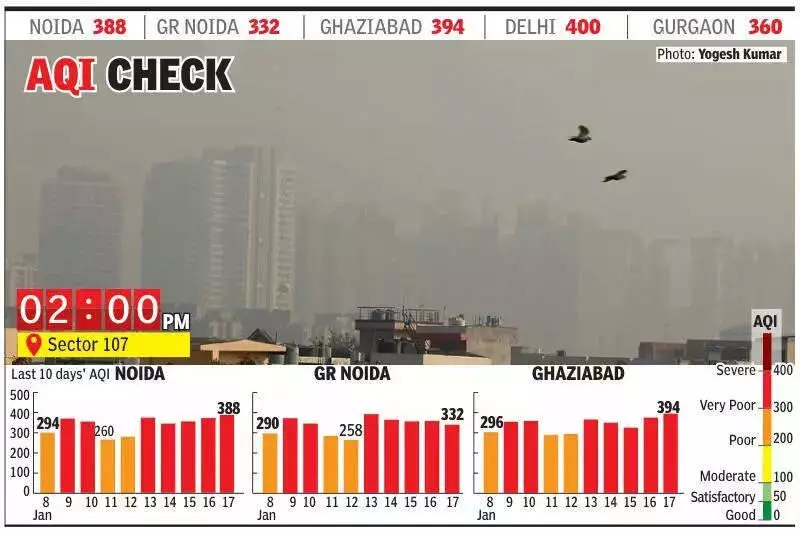
Air pollution levels in Noida took a turn for the worse on Saturday. The city's overall Air Quality Index climbed to 388, placing it firmly in the 'very poor' category. This marked a noticeable decline from Friday's reading of 363.
Neighboring Ghaziabad witnessed an even steeper increase. Its AQI jumped sharply to 394 from 376 the previous day. In contrast, Greater Noida experienced a slight improvement, with its index dropping to 332 from 358.
Local Monitoring Stations Paint a Grim Picture
Data from individual monitoring stations revealed concerning hotspots across the region:

- Noida: Sector 1 recorded a 'severe' AQI of 413. Sector 125 reported 381, while Sectors 116 and 62 both registered 378, all in the 'very poor' range.
- Greater Noida: Knowledge Park V measured 360 and Knowledge Park III recorded 304, both categorized as 'very poor'.
- Ghaziabad: The situation appeared most critical here. Vasundhara (454), Loni (427), and Indirapuram (419) all recorded 'severe' pollution levels. Only Sanjay Nagar fared slightly better with a 'poor' AQI of 314.
Weather Conditions Hinder Pollution Dispersion
Meteorological factors played a significant role in the deteriorating air quality. According to the Indian Institute of Tropical Meteorology, surface winds on Saturday primarily blew from the south-east. Wind speeds remained sluggish, dropping below 10 kmph in the afternoon.
Conditions worsened by evening. Wind speeds decreased further to just 5 kmph, shifting to an easterly direction and persisting through the night. This calm weather severely limited the natural dispersal of pollutants.
Sunday's Forecast and Official Response
The forecast for Sunday offers little immediate relief. Meteorologists predict a partly cloudy sky with moderate to dense fog in isolated areas during the morning. Winds are expected to remain weak, primarily from the east at speeds below 8 kmph in the morning. A slight increase to 10 kmph is anticipated in the afternoon before dropping back to 5 kmph by evening.
Saturday's weather saw a maximum temperature of 22 degrees Celsius and a minimum of 6 degrees. Morning visibility was severely impacted, dropping to as low as 200 meters in many areas.
In response to the crisis, authorities have taken decisive action. The Commission for Air Quality Management sub-committee unanimously decided to implement all measures under GRAP Stage-IV across the entire National Capital Region. This 'Severe+' action plan, triggered when the AQI surpasses 450, takes effect immediately to prevent further deterioration.
Delhi's own air quality mirrored the regional trend, rising from 400 at 4 PM to 428 by 8 PM on Saturday. Experts attribute this spike to a combination of western disturbances, calm winds, and poor pollutant dispersion.
District Administration Issues Safety Advisory
With dense fog expected, the district administration has released a crucial advisory for drivers:
- Reduce vehicle speed significantly, as controlling a vehicle becomes difficult at high speeds in fog.
- Always use fog lights while driving under these conditions.
- Maintain a safe distance from other vehicles on the road.
- Avoid unnecessary overtaking maneuvers, which substantially increase the risk of accidents.
The advisory, issued via a press statement, emphasizes caution during the prevailing inclement weather conditions. Residents are urged to stay informed and take necessary precautions for their health and safety.