Noida and Ghaziabad Grapple with Deteriorating Air Quality as AQI Enters 'Poor' and 'Very Poor' Categories
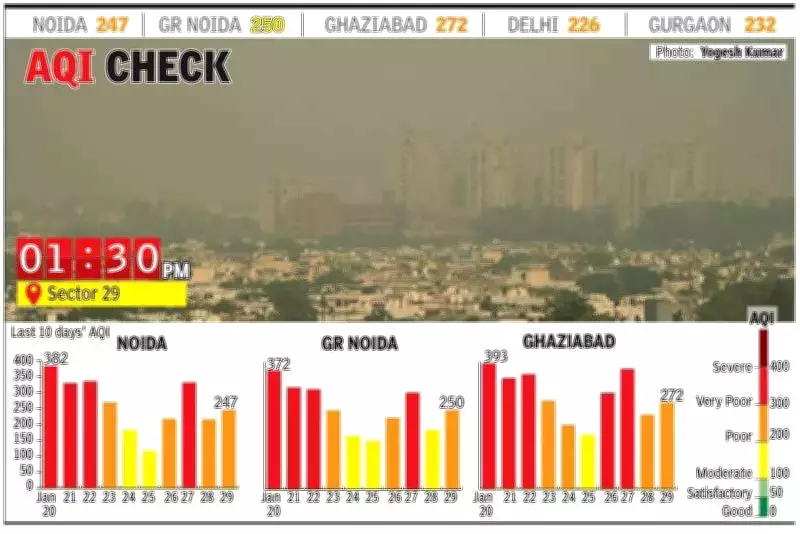
The air quality in the National Capital Region (NCR) took a concerning turn on Thursday, with multiple cities recording significant deterioration. Noida witnessed a notable decline, logging an Air Quality Index (AQI) of 247, which falls squarely within the 'poor' category. This marked a sharp increase from Wednesday's reading of 217, indicating a worsening pollution scenario over a 24-hour period.
Regional AQI Readings Show Widespread Pollution Concerns
Greater Noida also experienced a marginal shift in air quality, with its AQI climbing to 272 from 234 the previous day. Meanwhile, Ghaziabad faced a more severe situation, as its AQI worsened significantly to 250, moving from the 'moderate' range of 189 into the 'poor' category. Delhi, the capital city, similarly recorded 'poor' air quality with an AQI of 226, reflecting a broader regional issue.
According to data from the Central Pollution Control Board (CPCB) portal, specific monitoring stations in Noida painted a grim picture. On Wednesday, Sector 1 recorded an AQI of 264, Sector 116 logged 262, and Sector 125 registered 259, all firmly in the 'poor' range. Sector 62 offered a slight respite with an AQI of 197, which is categorized as 'moderate'.

Ghaziabad Stations Record Alarming 'Very Poor' Levels
In Greater Noida, both Knowledge Park V and Knowledge Park III stations reported 'poor' air quality, with AQIs of 292 and 207 respectively. The situation in neighboring Ghaziabad was even more alarming. Vasundhara recorded the worst AQI at 301, placing it in the 'very poor' category. Other stations in Ghaziabad, such as Loni with an AQI of 295 and Indirapuram at 294, remained in the 'poor' range. Sanjay Nagar was the sole station to record 'moderate' air quality, with an AQI of 199.
Weather Conditions and Forecast Point to Continued Challenges
The Indian Institute of Tropical Meteorology (IITM) provided insights into the meteorological factors contributing to the poor air quality. On Thursday, surface winds originated from the northwest direction, with speeds less than 15 kmph during the afternoon. These winds decreased further to 10 kmph in the evening and night, limiting the dispersion of pollutants.
Looking ahead to Friday, the forecast predicts a generally cloudy sky with shallow fog in many areas and moderate fog at isolated places during the morning hours. The predominant surface wind is expected to continue from the northwest, with speeds below 10 kmph in the morning. Wind speed may increase to 12 kmph in the afternoon before dropping to 5 kmph in the evening and night, suggesting that pollution dispersal will remain limited.
Temperature and visibility data added to the concerns. On Thursday, the maximum temperature was recorded at 17.9°C, with a minimum of 11°C. Visibility remained poor in the morning hours, dropping below 500 meters in the city, which can exacerbate health risks and disrupt daily activities.
This persistent air quality issue underscores the ongoing environmental challenges in the NCR, with residents advised to take necessary precautions, especially those with respiratory conditions. The combination of low wind speeds, fog, and stagnant conditions is likely to keep AQI levels elevated in the coming days, necessitating continued monitoring and public awareness.