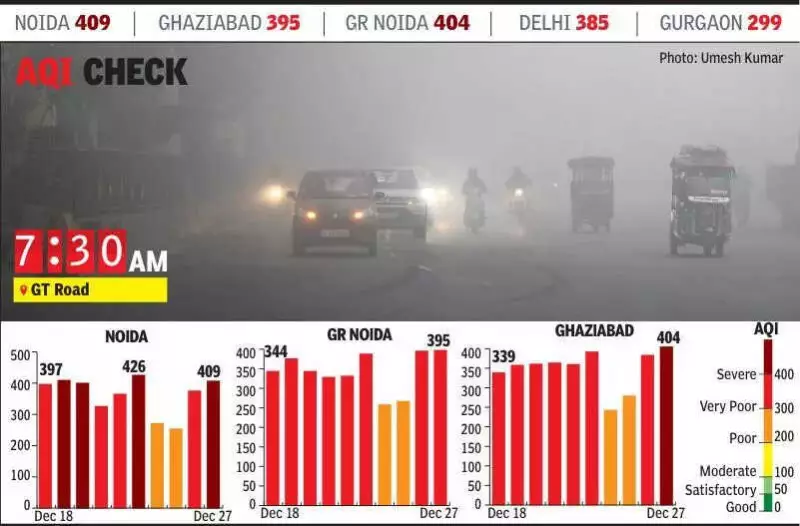
A thick, hazardous shroud of smog engulfed the Delhi-National Capital Region (NCR) on Saturday, marking a sharp and dangerous decline in air quality. Within a single day, the satellite cities of Noida and Ghaziabad witnessed their air pollution levels escalate from the 'very poor' to the 'severe' category, posing serious health risks to residents.
Noida Emerges as National Pollution Hotspot
According to the latest data released by the Central Pollution Control Board (CPCB), Noida earned the dubious distinction of recording the country's worst air quality by 4 pm on Saturday. The city's overall Air Quality Index (AQI) surged to 409, a significant jump from the 376 registered on Friday. This plunge into the 'severe' zone comes after a brief respite earlier in the week, which had interrupted a relentless 13-day streak of 'very poor' and 'severe' air that began on December 11.
Monitoring stations across Noida painted a grim picture. The situation was most critical in Sector 1, where the AQI touched 447, and in Sector 116 at 419, both firmly in the 'severe' range. Other areas like Sector 125 (AQI 394) and Sector 62 (AQI 377) remained in the 'very poor' category but were alarmingly close to the severe threshold.

Ghaziabad and Greater Noida Follow Alarming Trend
The neighbouring city of Ghaziabad mirrored Noida's distress, with its AQI deteriorating to 404 from 382, also entering the 'severe' category. In Greater Noida, the overall air quality lingered in the 'very poor' band, inching up to 395 from 394. However, specific localities within Greater Noida experienced severe pollution levels. Notably, Knowledge Park V recorded an AQI of 417, while Knowledge Park III registered 373.
The capital city of Delhi was not spared either. Its air quality worsened, climbing to the higher end of the 'very poor' category with an AQI of 385. The day was marked by moderate fog across the region, with visibility dropping to as low as 400 metres in places.
Calm Winds and Fog Trap Pollutants Near Surface
Officials and meteorological experts have pinpointed the primary culprits behind this rapid deterioration. A combination of calm winds, fog, and low temperatures created a lid over the region, preventing the dispersal of harmful pollutants.
Data from the Indian Institute of Tropical Meteorology (IITM) indicated that winds were predominantly weak, blowing from the north-west. Wind speeds stayed below 15 kmph during the afternoon and dropped to under 5 kmph by evening and night. This near-stagnant condition allowed emissions from vehicles, industry, and other sources to accumulate near the ground level, leading to the dense smog blanket.
The weather outlook offers little immediate relief. The India Meteorological Department (IMD) has issued a yellow alert for dense fog in isolated areas on Sunday morning. Winds are predicted to remain weak, under 10 kmph in the morning and falling to around 5 kmph by evening, conditions conducive to pollution buildup. The IMD forecasts partly cloudy skies in the coming days, with December 30 likely to be mainly clear. On Saturday, the maximum temperature settled at 22.2 degrees Celsius (two notches above normal), while the minimum was 7.8 degrees Celsius (one degree above normal).