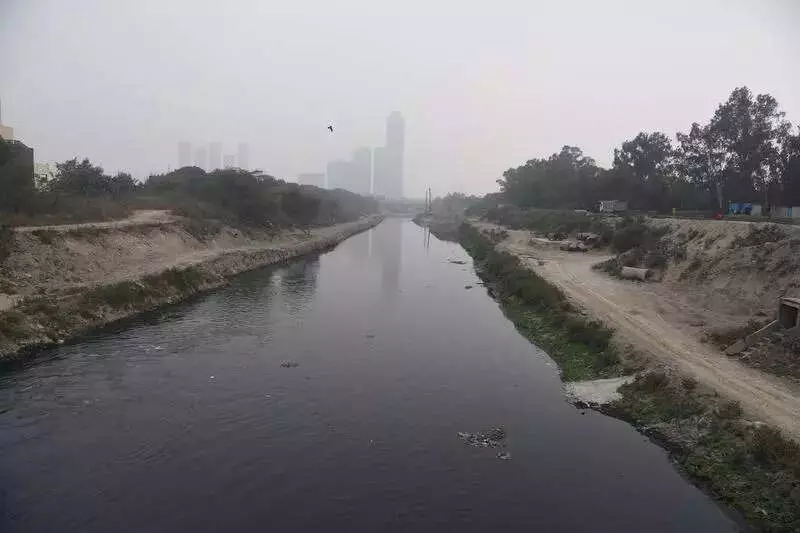
In a significant move to combat river pollution, the Noida Authority on Saturday gave its official nod to a detailed, phased plan for treating wastewater currently flowing untreated through the city's drainage network. The ambitious project aims to intercept sewage before it enters the Kondli irrigation drain and ultimately the Yamuna River.
NGT Directive Spurs Action
The board's approval follows specific directions from the National Green Tribunal (NGT) in the Abhisht Kusum Gupta versus State of UP case. The tribunal had mandated urban authorities to prevent the discharge of untreated wastewater into irrigation drains. Complying with an NGT order dated August 3, 2022, the Authority engaged CSIR-National Environmental Engineering Research Institute (NEERI) to conduct a thorough assessment. A formal Memorandum of Understanding (MoU) between Noida Authority and NEERI was signed on July 21, 2022.
NEERI's study surveyed approximately 30 drains within the Authority's jurisdiction. It identified 24 active drains, coded D1 to D24, with the remaining found dry or inactive. These active channels were categorized based on their discharge volume and pollution load, forming the basis for the treatment strategy.

Phased Implementation and Major Infrastructure Projects
Work has already begun on the ground as part of ongoing compliance. Authorities have intercepted Drain D20 at the Sewage Pumping Station (SPS) in the Hosiery Complex area. Drains D6, D7, and D8 have been trapped at sump wells in Sector 33. No action is needed for Drain D2 (dry) and D5, which already carries treated effluent from an existing plant.
The board has set clear deadlines for intercepting additional drains by June 2026. This includes tapping Drains D10 and D11 at the Sewage Treatment Plant (STP) in Sector 50, and intercepting Drain D18 at the SPS in Bhangel, Sector 106, to divert flows to treatment facilities.
For major, heavily polluted drains, the Authority cleared the construction of dedicated STPs. It approved Detailed Project Reports (DPRs) prepared by NEERI for three key drains:
- Drain D3 near Summer Villa School in Sector 22
- Drain D21 along Gejha Road near the biodiversity park
- Drain D24 from Sector 126 towards Mayur School
These plants will use Moving Bed Biofilm Reactor (MBBR) technology and are to be built at a combined estimated cost of around Rs 75 crore, targeting completion by June 2027.
In a major infrastructure push, a separate STP for Drain D22—which runs from the Mahamaya Flyover area in Sector 44 towards Panchsheel—was also approved. This facility alone involves an estimated investment of Rs 127.5 crore and is scheduled for completion by June 2027.
Roadmap to a Cleaner Yamuna
The plan outlines a comprehensive roadmap extending to December 2028. For other major drains like D4, D9, D12, D15, D16, and D19, NEERI will submit DPRs later, with treatment works scheduled in subsequent phases.
For drains with low to moderate pollution, such as D13, D14, D17, and D23, officials approved the use of bioremediation and phytoremediation methods near existing pumping stations. These natural treatment processes are deemed suitable given the lower discharge volumes.
During the meeting, officials noted correspondence with the Central Pollution Control Board (CPCB), which clarified it does not approve specific sewage treatment technologies. Compliance will be assessed against discharge standards set by state pollution boards through the consent mechanism.
With the plan approved, the Authority will now move to the execution stage. This involves inviting expressions of interest, evaluating proposals through a technical committee, and issuing requests for proposals for the construction, operation, and maintenance of the approved projects. This phased implementation is expected to significantly strengthen wastewater management in Noida and address long-standing pollution concerns in the drains that feed the Yamuna.