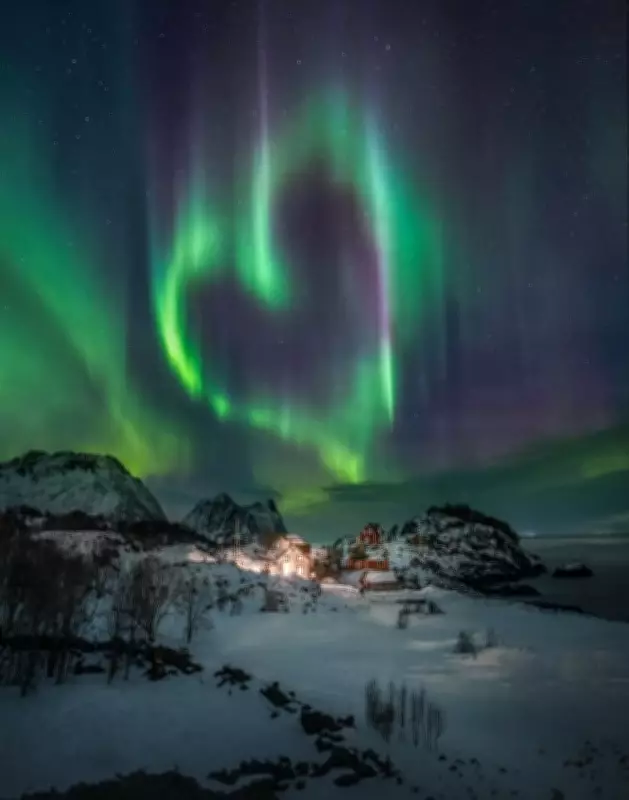
Celestial Valentine: Norway's Northern Lights Transform into Glowing Heart
In a stunning display of nature's artistry, the Northern Lights in Norway recently morphed into a perfect, glowing heart shape, creating a celestial Valentine that has mesmerized observers across the globe. This rare and breathtaking phenomenon occurred during a period of heightened solar activity, which intensified the Aurora Borealis, allowing it to form this symbolic and romantic configuration against the Arctic night sky.
A Rare and Photogenic Phenomenon
The event was captured by both amateur and professional photographers in northern Norway, particularly in regions like Tromsø and the Lofoten Islands, where clear, dark skies provided an ideal backdrop. The heart-shaped aurora appeared as vibrant green and pink hues, typical of the Northern Lights, but arranged in a distinct, symmetrical pattern that resembled a massive, luminous heart. This occurrence is exceptionally rare, as auroras typically manifest as curtains, arcs, or diffuse glows, rather than well-defined shapes like hearts.
Scientists attribute this formation to specific geomagnetic conditions and solar wind interactions with Earth's atmosphere. When charged particles from the sun collide with gases like oxygen and nitrogen, they emit light, creating the aurora. In this instance, the magnetic field lines and atmospheric currents aligned in such a way that the lights coalesced into a heart shape, a fleeting moment of celestial serendipity.

Global Reaction and Social Media Buzz
The images and videos of the heart-shaped Northern Lights quickly went viral on social media platforms, with users dubbing it a "Celestial Valentine" or "Nature's Love Letter." Many have shared the photos as a symbol of hope and beauty during times of global uncertainty, while others have expressed awe at the sheer improbability of such a perfect natural formation. Tourism officials in Norway have noted increased interest in Northern Lights tours following this event, as travelers hope to witness similar magical displays.
This phenomenon underscores the unpredictable and wondrous nature of the Aurora Borealis, which continues to inspire both scientific curiosity and artistic appreciation. While heart-shaped auroras are not common, they remind us of the Earth's dynamic connection to solar events and the endless surprises our planet's atmosphere can offer.
Tips for Viewing the Northern Lights
For those inspired to see the Northern Lights themselves, here are some key tips:
- Visit during the winter months, from September to March, when nights are longest and skies are darkest in polar regions.
- Choose locations with minimal light pollution, such as remote areas in Norway, Iceland, or Canada.
- Monitor solar activity forecasts, as higher solar wind speeds increase the likelihood of vivid auroras.
- Be patient and allow multiple nights for viewing, as auroral displays can be unpredictable.
This celestial heart event serves as a poignant reminder of the beauty that can emerge from natural processes, blending science and symbolism in a way that captivates hearts and minds worldwide.