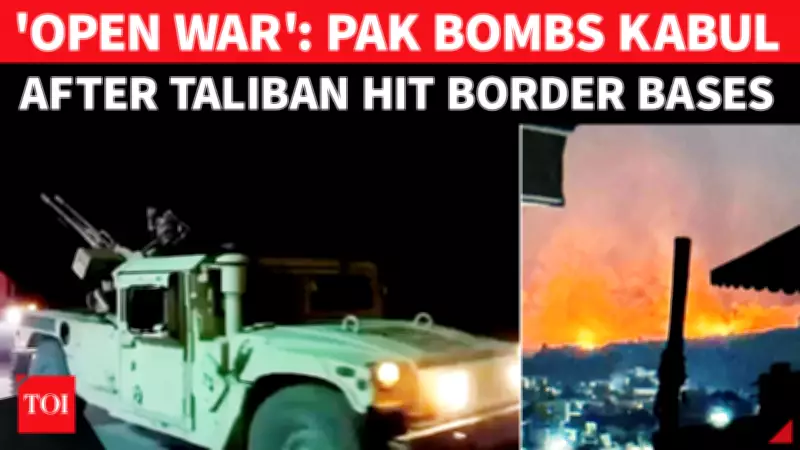
Pakistan Launches Airstrikes on Afghan Cities After Border Clash
In a dramatic escalation of tensions, the Pakistan Air Force conducted bombing raids on the Afghan cities of Kabul and Kandahar early Friday. This military action came in direct response to a surprise attack by Afghan forces, believed to be aligned with the Taliban, which targeted Pakistani troops stationed along the contentious Durand Line border region.
Border Blitz Sparks Widespread Conflict
The initial confrontation began when Afghan forces launched what Pakistan has described as an unprovoked assault on its military posts. This border blitz resulted in the capture of several Pakistani soldiers and significant casualties on both sides. The fighting quickly spread to the critical Torkham border crossing, a major trade and transit point between the two nations.
The situation at Torkham deteriorated rapidly, forcing local authorities to initiate emergency evacuations as mortar fire rained down on nearby villages. Civilian populations found themselves caught in the crossfire, with reports of property damage and displacement emerging from the affected areas.

Conflicting Casualty Reports and Accusations
Both Pakistan and Afghanistan have acknowledged suffering heavy losses in the exchange, but their official statements present sharply divergent figures. The lack of independent verification in the conflict zone has made it challenging to ascertain the precise human toll of the clashes.
Diplomatic rhetoric has intensified alongside the military actions. The Afghan government has issued a formal protest, accusing Pakistan of violating its national sovereignty through the airstrikes on its urban centers. "This represents a clear breach of international law and an attack on our territorial integrity," an Afghan spokesperson stated.
Conversely, Islamabad has defended its actions as a necessary response to aggression. Pakistani officials characterized the initial Afghan assault as an unprovoked act of hostility that demanded a firm military response to protect national security and its personnel.
Regional Implications and Escalation Risks
This outbreak of violence marks one of the most serious escalations in recent years along the historically volatile Durand Line. The border, which was established in 1893 and spans approximately 2,640 kilometers, has never been formally recognized by Afghanistan, creating a persistent source of bilateral tension.
The extension of hostilities beyond the immediate border area to include airstrikes on major Afghan cities represents a significant broadening of the conflict. Security analysts are expressing concern that this could spiral into a more protracted military engagement, with potential implications for regional stability across South Asia.
International observers are closely monitoring the situation, particularly given the complex geopolitical dynamics involving neighboring powers and the ongoing challenges of governance in Afghanistan since the Taliban's return to power. The incident underscores the fragile security environment in the region and the persistent border disputes that continue to fuel instability.